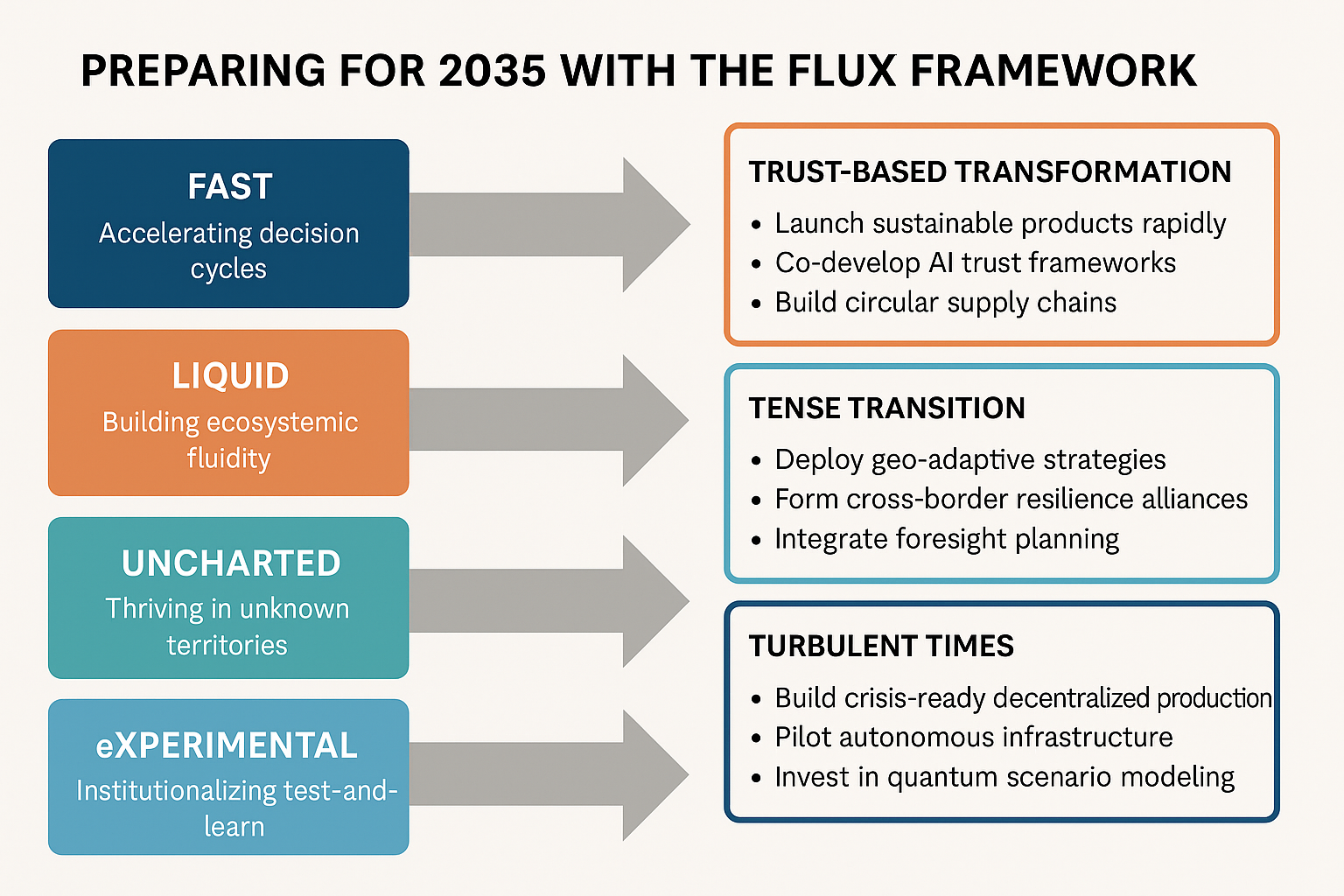

What 2035 Holds: AI, Climate, and Geopolitics Outlook

🌍 2035 Executive Summary

Scenarios & Strategic Outlook

By 2035, the global landscape will be shaped by the interplay of AI, climate change, and geopolitics.
Three plausible scenarios emerge:

  • Trust-Based Transformation (35% likelihood)
  • Tense Transition (45% likelihood)
  • Turbulent Times (20% likelihood)

This executive summary presents a probability-weighted outlook combining all three scenarios to guide strategic decision-making.


🔑 Key Insights for 2035

  • Global GDP → Expected to grow by ~18% from 2025 levels, but regional disparities persist.
  • AI Adoption → Moderate-to-high (~65% penetration), though fragmentation slows interoperability.
  • Climate Trajectory → Warming projected around +2.4 °C by 2100, increasing economic damages and disaster frequency.
  • Jobs & Skills → Net job losses of ~15% likely in low- and mid-skill sectors; massive reskilling efforts will be critical.
  • Inequality → Expected to widen slightly unless proactive redistribution and upskilling policies are implemented.
  • Energy Transition → On track for ~60% decarbonization by 2035, but net zero by 2050 remains unlikely without acceleration.
  • Geopolitics → Increasing regional blocs and moderate instability; limited global coordination.
  • Social Trust → Partial recovery possible, but misinformation and AI distrust remain key risks.

📊 Scenario Probability Overview

ScenarioProbabilityKey Characteristics
Trust-Based Transformation35%Responsible AI, strong global cooperation, rapid sustainability gains
Tense Transition45%Fragmented AI ecosystems, uneven economic gains, rising climate costs
Turbulent Times20%Conflict, tech distrust, climate chaos, institutional fragility


🚀 Strategic Recommendations

  1. Invest in Responsible AI
    • Prioritize human-centered, transparent AI to build trust and ensure equitable adoption.
  2. Accelerate Decarbonization
    • Push investments in renewable energy, carbon capture, and climate adaptation technologies.
  3. Strengthen Workforce Resilience
    • Implement large-scale reskilling programs to offset automation-driven job losses.
  4. Foster Global Cooperation
    • Align AI ethics, cybersecurity standards, and climate policies to reduce fragmentation risks.
  5. Prepare for Instability
    • Build contingency plans for supply chain disruptions, cyber threats, and climate shocks.

More info about FLUX framework:

Cultivating cognitive collaboration with AI

It is not about deploying AI tools

The rapid adoption of AI, exemplified by ChatGPT’s unprecedented growth, presents a clear inflection point.

While many organizations are focused on simply deploying AI tools, the true competitive advantage lies in developing a cognitive collaboration with AI.

This shift in mindset from implementation to collaboration is essential for fundamentally enhancing human problem-solving capacity and unlocking substantial productivity gains.


The Gap: AI Literacy vs. Productivity Gains

Current data highlights a stark contrast: a significant majority (74%) of individuals lack AI literacy, yet a large percentage (88%) of AI collaborators report substantial productivity gains. This indicates that the benefits of AI are not reserved for a tech-savvy elite. Instead, they are accessible to those who learn to effectively partner with these tools. The key is to move beyond viewing AI as a simple tool and instead see it as a partner in a cognitive process. This partnership allows for a synergistic relationship where the AI augments human strengths, and humans provide the context, creativity, and critical thinking that AI currently lacks.


The synergy: faster completion and higher quality

MIT research validates this synergistic effect, showing that AI collaboration leads to a 40% faster completion time and an 18% superior output quality.

This is not about the AI doing the work for us; it’s about the combined effort of human and machine.

Consider a data analyst using an AI to quickly process and visualize a massive dataset.

The AI handles the computational heavy lifting, identifying patterns and generating charts, while the human provides the domain expertise to interpret the findings and derive strategic insights.

This is a powerful example of AI as a cognitive co-pilot.


The strategic shift: from tools to capabilities

Organizations that only ask about AI implementation are focused on the « how-to » of tool deployment, which is a transactional approach.

They are merely adopting new software. In contrast, organizations that ask about AI collaboration are focused on the « how-to » of building new cognitive capabilities within their workforce.

This strategic insight explains the 13.8% productivity improvements seen in these forward-thinking organizations.

They are not just leveraging a tool; they are developing a new way of working that fundamentally alters their problem-solving capacity.


Our approach: developing cognitive collaboration

To foster this cognitive collaboration, organizations and individuals must focus on three key areas:

  • Upskilling in AI Literacy: This goes beyond basic familiarity with AI tools. It involves understanding the strengths and limitations of AI, knowing how to formulate effective prompts, and critically evaluating AI-generated outputs. It is about learning to speak the language of AI.
  • Developing a Collaborative Mindset: Encourage a culture where AI is seen as a partner, not a replacement. Promote experimentation and shared learning. This shift in mindset is crucial for fostering an environment where individuals feel empowered to explore how AI can augment their unique skills.
  • Integrating AI into Workflows: Rather than using AI as a standalone tool, integrate it directly into existing problem-solving workflows. This could involve using AI to brainstorm ideas, analyze complex data, draft initial documents, or even simulate different scenarios. The goal is to make AI a seamless part of the cognitive loop, where humans and machines continuously inform and enhance each other’s work.

By embracing this strategic shift from simply deploying tools to actively building enhanced cognitive capabilities, organizations can move beyond mere adoption and truly leverage AI to solve problems in ways that were previously unimaginable.

The future of work is not about humans vs. AI, but about humans with AI. 

The AI advantage

Mastering Negotiation in the Digital Age

Negotiation. It’s an art as old as commerce itself, a delicate dance of give and take that has shaped human interaction for millennia. From ancient bazaars to modern boardrooms, the core principles have remained remarkably consistent. But what if the very essence of this age-old art is on the cusp of a revolutionary transformation? What if the future of negotiation isn’t just about human skill, but about leveraging the unparalleled power of artificial intelligence?

The answer lies in « The AI Advantage: Mastering Negotiation in the Digital Age, » an essential guide that reveals how AI isn’t just a futuristic concept, but a present-day game-changer for anyone involved in high-stakes interactions.

This groundbreaking e-book goes far beyond traditional negotiation tactics, demonstrating how cutting-edge AI empowers you to win like never before.

Unlocking Unprecedented Insights

Imagine having the ability to sift through mountains of data – from intricate market trends to exhaustive counterparty profiles – at speeds that are simply impossible for the human mind.

AI makes this a reality. It can uncover unprecedented insights, giving you a panoramic view of the negotiation landscape.

This isn’t just about knowing more; it’s about knowing everything relevant, allowing you to enter discussions armed with a level of understanding that was previously unimaginable.

Predicting outcomes with uncanny accuracy

Ever wish you could peek into the future of a negotiation?

AI brings you remarkably close. Through powerful predictive analytics, you can simulate countless scenarios, testing different offers and counter-offers to identify the optimal path forward.

This capability allows you to anticipate reactions from the other side with uncanny accuracy, reducing uncertainty and enabling more strategic decision-making. No more guessing games; just data-driven foresight.

Automating routine, elevating strategy

Let’s be honest: some aspects of negotiation are tedious.

Contract review, initial communications, and basic information gathering can consume valuable time and energy.

AI can automate routine tasks, streamlining these processes and freeing you up to focus on what truly matters: high-value strategy, creative problem-solving, and cultivating strong relationships.

This isn’t about replacing the human element, but about enhancing it.

Enhancing your human intuition

Perhaps one of the most exciting aspects of AI in negotiation is its ability to enhance your human intuition.

By analyzing communication styles, subtle emotional cues, and behavioral patterns, AI provides data-driven insights that can make you a more empathetic, perceptive, and ultimately, more effective negotiator. It’s about augmenting your natural abilities, not diminishing them.

You become a sharper observer and a more astute communicator.

Real-World Impact and a Glimpse into the Future

« The AI Advantage » isn’t just theoretical; it explores real-world case studies demonstrating AI’s tangible impact across various fields, including procurement, sales, and legal negotiations.

You’ll see how organizations and individuals are already leveraging AI to secure better terms and maximize value.

Looking ahead, the book offers a thrilling glimpse into the future of negotiation, envisioning hyper-personalized strategies, advanced emotional AI that understands and responds to nuanced human emotions, and even autonomous negotiation agents capable of executing agreements with minimal human intervention.

Most importantly, this e-book teaches you how to embrace the « augmented negotiator » mindset. This isn’t about choosing between human skill and AI power; it’s about seamlessly combining AI’s analytical prowess with your unique human empathy, creativity, and strategic thinking.

Whether you’re a seasoned dealmaker looking for an edge or new to the intricate art of persuasion, « The AI Advantage: Mastering Negotiation in the Digital Age » provides the definitive blueprint for securing better terms, maximizing value, and achieving unparalleled success in our rapidly evolving digital world. Don’t just negotiate; master it with the AI advantage.

Share this invaluable resource with your network!

This e-book is just one piece of the puzzle!

  • About the Author: Want to learn more about my background, expertise, and what drives my passion for helping professionals like you succeed?
  • Visit my Author profile here. https://www.amazon.com/stores/Yves-Zieba/author/B0FJWXC2XF
  • Discover my collections: We have a wealth of resources, articles, and other e-books designed to help you master various aspects of your professional life.

Share your thoughts in the comments below!

Proposition quotidienne de rédaction
Si vous pouviez faire revenir un dinosaure, lequel choisiriez-vous ?

Note : 1 sur 5.

Unlock Your Career Potential: 100 AI Tools and Strategies


Discover « 100 AI-Powered Career Management Use Cases » E-book!


Are you ready to redefine your career in the age of AI?

Artificial Intelligence isn’t just a buzzword; it’s your new co-pilot in navigating the complexities of the modern job market. Imagine having a secret weapon that helps you find dream opportunities, build in-demand skills, and showcase your unique talents like never before.

That’s exactly what you’ll find in our brand new, comprehensive e-book: « 100 AI-Powered Career Management Use Cases. »


Why you need this e-book NOW:

In today’s fast-paced world, staying ahead means leveraging every tool at your disposal.

This isn’t just theoretical fluff; it’s 100 practical, actionable ways you can use AI, right now, to transform your professional journey.

  • For Job-Seekers: Stop endless scrolling. Discover hidden opportunities and tailor your applications with laser precision.
  • For Early-Career Professionals: Accelerate your growth, build essential skills, and make an impact from day one.
  • For Seasoned Experts: Adapt to new industry trends, expand your influence, and future-proof your expertise.
  • For Freelancers & Entrepreneurs: Streamline your operations, find new clients, and build your personal brand with unprecedented efficiency.
  • For Managers & Leaders: Empower your teams, optimize performance, and lead with AI-driven insights.

If you’re serious about taking control of your career and thriving in the AI-driven future of work, this e-book is your ultimate guide.


What’s inside? A sneak peek at how AI will supercharge your career:

We’ve broken down AI’s power into digestible, actionable use cases, each designed for immediate application. Here’s a glimpse of the transformative areas covered:

1. Finding Opportunities (1-15)

  • Identify Emerging Job Roles: Stay ahead of the curve and pinpoint where your skills will be most valued in the coming years.
  • Personalize Job Alerts: Ditch the noise and get highly relevant job recommendations tailored just for you.
  • Research Company Culture & Values: Find the perfect fit by using AI to understand a company’s true ethos.

2. Building Your Brand (16-25)

  • Craft a Powerful Personal Brand Statement: Articulate your unique value proposition in a way that resonates.
  • Optimize LinkedIn Profile for Searchability: Get found by recruiters with AI-suggested keywords and compelling content.
  • Develop a Content Strategy for Thought Leadership: Become an industry authority by sharing AI-assisted insights.

3. Upskilling & Learning (26-40)

  • Identify Skill Gaps for Career Advancement: Pinpoint exactly what you need to learn to reach your next professional milestone.
  • Recommend Personalized Learning Resources: Get tailored course suggestions, articles, and videos that match your learning style and goals.
  • Summarize Complex Technical Concepts: Grasp intricate ideas in minutes, not hours.

4. Application Materials (41-50)

  • Tailor Your Resume to a Specific Job Description: Beat the Applicant Tracking Systems (ATS) and make every application count.
  • Draft a Compelling Cover Letter: Write persuasive letters that showcase your enthusiasm and fit.
  • Proofread and Grammar Check All Materials: Ensure flawless applications every time.

5. Interview & Assessment (51-60)

  • Prepare for Behavioral Interview Questions: Craft powerful STAR method answers that highlight your strengths.
  • Simulate Mock Interviews (Chat-based): Practice under pressure and refine your responses with AI as your interviewer.
  • Generate Questions to Ask the Interviewer: Impress hiring managers with insightful inquiries.

…and 40 more game-changing use cases across Onboarding, Productivity, Leadership, and Career Transitions!


Your AI Co-Pilot awaits – Invest in your future!

This e-book is designed to be your quick-start guide, packed with immense value for your career. Each use case includes:

  • Why it matters – the problem it solves.
  • How AI helps – the core mechanism.
  • Example tools – software or services you can use (like ChatGPT, Gemini, Microsoft Copilot, LinkedIn, Notion AI, and more!).
  • Quick-start steps – a tiny workflow you can adopt today.
  • Pro tips – advanced or cautionary advice.

No complicated setups, no obscure software needed. Just practical, immediate ways to put AI to work for YOUR career. Think of this as your personal career consultant, available 24/7.


Ready to revolutionize your career?

Don’t get left behind. The future of work is here, and AI is your most powerful ally.

This e-book is your essential investment in staying ahead.

Share this invaluable resource with your network! Help your friends, colleagues, and connections supercharge their careers too.

Loved this deep dive into AI and career management? This e-book is just one piece of the puzzle!

What career challenge are you hoping AI will help you solve first? Share your thoughts in the comments below!

Proposition quotidienne de rédaction
Si vous pouviez faire revenir un dinosaure, lequel choisiriez-vous ?

Note : 1 sur 5.

The Tiny Team Revolution: Redefining Success for Innovative Projects


Small teams, big results

For years, the sheer size of a company’s workforce was often seen as the ultimate badge of honor, a clear signal of success. The bigger the headcount, the more impressive the achievement.

But as we stand in 2025, amidst the revolutionary wave of artificial intelligence and the rise of lean startups, that narrative has fundamentally shifted.

The focus is no longer on how many people you employ, but on how much a small, agile team can accomplish.

This isn’t merely about cutting costs; it’s a complete paradigm shift in how companies are built and what success truly looks like. We’re entering the age of the tiny team: lean, focused, and incredibly impactful. The question for anyone embarking on an innovative project today is, are you ready for it?


The New Formula: Small Teams, Big Results

Gone are the days when growth was exclusively measured in employees. Today, the metric that truly matters is productivity per person.

Consider the example of Gamma, a company that serves 50 million users with a mere 28 employees, has raised $23M, and has been profitable for over 15 months.

This isn’t magic; it’s leverage. Each team member is a generalist, empowered by powerful AI tools, operating without the traditional silos or managerial bloat.

This clear, high-output execution is rapidly becoming the blueprint for success.


Why Big Teams are now a Red Flag

Where investors once applauded a large headcount, they now scrutinize it.

A bulky team often signals inefficiency, outdated thinking, and a resistance to the rapid changes demanded by today’s landscape.

We’re on the cusp of a world where zero-employee, billion-dollar companies are no longer a fantasy.

Today’s venture capitalists are actively seeking speed, adaptability, and leverage.

They aren’t interested in funding cumbersome organizations. They want focused operators equipped with the right tools, not suffocated by hierarchies.

You no longer need a team of data analysts; you need someone adept at prompting GPT.

You don’t need ten marketers; you need one who deeply understands growth strategies and automation.


Flexibility over Rigid Structures, embracing FLUX

The traditional startup model often mirrored factory assembly lines: specialized roles, multiple layers of management, and rigid processes.

However, AI doesn’t conform to traditional organizational charts. It thrives on initiative, flexibility, and autonomy.

Companies like Gamma succeed because their team members are player-coaches – simultaneously executing tasks and leading their areas. This model champions agility and sound judgment over strict adherence to procedure.

For these tiny, innovative teams, frameworks like FLUX are particularly appropriate. FLUX, standing for Fast, Liquid, Uncharted, and eXperimental, encapsulates the very essence of what makes small teams thrive in today’s dynamic business environment.

  • Fast: Tiny teams, unburdened by bureaucracy, can move with incredible speed, making rapid decisions and executing quickly. This aligns perfectly with the « Fast » principle of FLUX, emphasizing quick adaptation and responsiveness.
  • Liquid: Small teams are inherently more adaptable and less rigid than large organizations. They can easily reconfigure, pivot, and flow with changing market demands, embodying the « Liquid » aspect of the framework.
  • Uncharted: Innovative projects often venture into unknown territories. Tiny teams are better equipped to navigate these « Uncharted » waters, as they can collectively explore, learn, and iterate without the complexity of coordinating numerous stakeholders.
  • eXperimental: The lean nature of tiny teams fosters a culture of continuous experimentation and learning from failures, which is core to the « eXperimental » principle of FLUX. This allows them to rapidly test hypotheses and discover effective solutions.

By embracing the FLUX framework, tiny teams naturally cultivate the agility, collaboration, continuous learning, and forward-thinking mindset necessary to not just survive but truly thrive amidst constant change.


The strategic edge of tiny teams

Founders of innovative projects should actively resist the temptation of early bloat. Staying small for as long as possible offers a significant competitive advantage. Why?

  • Speed: Small teams move faster, with less friction.
  • Focus: Alignment is easier. Distractions are fewer.
  • Tool Leverage: AI tools empower fewer people to accomplish far more.
  • Resilience: Generalists can cover multiple roles when needed.
  • Efficiency: Lean teams use capital wisely, something investors value more than ever.

What investors prioritize in 2025

The venture capital mindset has undergone a profound transformation. The « scale-at-all-costs » mentality is out. Instead, investors are asking:

  • How much can this team achieve before they need to expand?
  • How efficient are they per person, per euro, per hour?
  • Are they obsessed with their product or their organizational structure?

Impact per head is the new north star.


The One-Person Startup: A future closer than you think

While we celebrate small teams today, tomorrow we might be applauding solo founders building entire companies from their laptops – not just hobby projects, but legitimate, investor-backed businesses. This isn’t science fiction. With the explosive pace of AI development, it’s already possible to:

  • Build and launch software without writing a single line of code.
  • Generate content, manage marketing campaigns, and handle customer support.
  • Oversee operations, analyze data, and conduct UX testing – all solo.

Soon, one person will effectively replace ten. Eventually, perhaps none will be needed for many tasks.


What this means for your innovative and organic project

If you’re launching an innovative project in 2025, it’s time to ask yourself some critical questions:

  • Am I hiring to look impressive, or because there’s a genuine, indispensable need for the help?
  • Can the combination of AI and highly capable generalists outperform the larger team I initially envisioned?
  • Am I chasing vanity metrics, or am I focused on achieving real, impactful traction?

In today’s landscape, you don’t win by being big. You win by being lean, fast, and remarkably sharp.

Unlock growth with RPA: Learn from the Automated CEO

🚀 New eBook Launch: The Automated CEO – Your Guide to Robotic Process Automation (RPA)

We’re thrilled to announce the release of our latest eBook, The Automated CEO — a must-read for today’s forward-thinking C-suite leaders who want to harness the full potential of Robotic Process Automation (RPA) to drive innovation, agility, and growth.

💡 What’s inside?
This comprehensive guide is more than theory — it’s packed with 100 actionable “power plays” that show you exactly how RPA can:

✅ Streamline operations and eliminate inefficiencies
✅ Slash costs and increase profit margins
✅ Enhance customer experiences through faster, smarter processes
✅ Free up human capital to focus on creativity, strategy, and value creation

Whether you’re leading in finance, human resources, supply chain, or cutting-edge industries like aerospace, fashion, or climate tech, this book gives you the strategic lens to reshape your business with intelligent automation.

📈 Build your RPA roadmap
Learn how to assess automation readiness, design scalable workflows, measure ROI, and inspire buy-in at every level of your organization. The Automated CEO walks you through the journey from pilot projects to enterprise-wide transformation.

🔥 Bust the myths – Embrace the future
Still think RPA is just about bots handling repetitive tasks? Think again. This eBook debunks common myths and reframes automation as a driver of human-centric, innovation-led growth.

Who should read this?

  • CEOs & Founders
  • CIOs, CTOs, COOs
  • Transformation leaders
  • Automation strategists
  • Innovation officers
  • Consultants and advisors

If you’re shaping the future of your organization, this guide is your blueprint.


🎯 Ready to Lead in the Age of Automation?

Download The Automated CEO today and become the visionary leader your business needs.

👉 https://www.amazon.fr/dp/B0FJT82649


More e-books available here : https://www.amazon.fr/s?i=digital-text&rh=p_27%3AYves%2BZieba&s=relevancerank&text=Yves+Zieba&ref=dp_byline_sr_ebooks_1

#RPA #Automation #DigitalTransformation #Leadership #FutureOfWork #Innovation #TheAutomatedCEO #CIO #COO #AI #Robotics #BusinessStrategy

Réduire son empreinte carbone : Scope 3 simplifié pour TPE/PME/ETI

Décarbonation du Scope 3 pour les TPE/PME/ETI : Un guide pratique pour agir

Votre TPE ou PME dans le secteur des services souhaite s’engager concrètement pour le climat ? Le Scope 3 vous semble complexe et intimidant ? Vous n’êtes pas seul ! La majorité de votre empreinte carbone est indirecte, provenant de vos achats, de vos déplacements et de vos activités numériques. Heureusement, nous avons une solution pour vous : l’e-book « Décarbonation du Scope 3 pour les TPE/PME ».

Pourquoi le Scope 3 est-il si important ?

Le Scope 3 inclut toutes les émissions de gaz à effet de serre (GES) générées par les activités de votre entreprise, mais qui ne sont pas directement sous votre contrôle. Cela englobe :

  • Les achats : matières premières et services que vous acquérez.
  • Les déplacements professionnels : voyages d’affaires, transports de vos employés.
  • La gestion des déchets : comment vous traitez vos produits en fin de vie.
  • La consommation numérique : le poids carbone de vos activités en ligne.

En comprenant et en mesurant ces émissions, vous pouvez agir de manière significative pour réduire votre impact environnemental.

Ce que vous allez découvrir dans cet E-Book

Une compréhension simplifiée du Scope 3

Cet e-book démystifie le concept de Scope 3, en le rendant accessible et pertinent pour les TPE/PME. Vous apprendrez :

  • Les enjeux spécifiques à votre secteur.
  • Comment identifier d’où proviennent vos émissions indirectes.

50 idées concrètes pour mesurer vos émissions

Vous trouverez des méthodes pratiques pour :

  • Collecter des données sur vos achats et vos déplacements.
  • Évaluer les trajets domicile-travail de vos employés.
  • Analyser votre gestion des déchets et votre consommation numérique.

Ces outils vous aideront à identifier vos « points chauds » carbone, avec des exemples adaptés à votre réalité.

50 Actions pratiques pour atteindre le « Net Zéro »

Le guide propose également des stratégies éprouvées pour réduire vos émissions, telles que :

  • Achats responsables : privilégier des fournisseurs locaux et écoresponsables.
  • Mobilité durable : encourager le télétravail et les transports en commun.
  • Gestion des déchets : mettre en place des solutions de recyclage efficaces.
  • Numérique sobre : optimiser vos outils numériques pour réduire leur empreinte.

Chaque action est détaillée pour faciliter son implémentation, avec une attention particulière portée aux initiatives locales et transparentes.

Pourquoi agir sur le Scope 3 ?

Atteindre le net zéro n’est plus une option, mais une nécessité. En agissant sur votre Scope 3, vous :

  • Renforcez votre image de marque.
  • Attirez de nouveaux talents.
  • Fidélisez vos clients.
  • Devenez un acteur clé de la transition écologique dans votre région.

Pour qui est cet e-book ?

Ce guide est destiné à tous les dirigeants, managers et employés de TPE/PME qui souhaitent passer de l’intention à l’action.

Avec des conseils pratiques et une vision claire, il vous permettra de générer un impact positif sur votre entreprise et l’environnement.

Conclusion

Ne laissez pas la complexité du Scope 3 vous freiner.

Téléchargez dès maintenant l’e-book « Décarbonation du Scope 3 pour les TPE/PME » et préparez votre entreprise pour un avenir plus durable et résilient.

Chaque petite action compte et peut contribuer à un changement significatif. Ensemble, agissons pour un climat meilleur !

L’IA pour un maintien à domicile sécurisé et autonome

Le maintien à domicile représente un enjeu crucial pour de nombreuses personnes âgées ou en situation de dépendance, leur permettant de préserver autonomie et qualité de vie.

Cependant, cette aspiration est souvent confrontée à des défis de taille pour les aidants familiaux et les professionnels de santé, notamment en matière de sécurité, de surveillance et de coordination des soins.

Et si l’intelligence artificielle (IA) était la solution pour surmonter ces obstacles et offrir un soutien sans précédent ?


L’IA au service d’un maintien à domicile serein et épanoui

Imaginez un quotidien où la technologie travaille de concert avec l’humain pour garantir sécurité, autonomie et bien-être.

C’est précisément la promesse de l’IA appliquée au maintien à domicile.

Loin des spéculations futuristes, l’IA déploie déjà des solutions concrètes et éprouvées qui révolutionnent le soutien aux personnes âgées et dépendantes.


Comment l’IA transforme le soutien aux personnes âgées et dépendantes

Je suis ravi d’annoncer le lancement de mon nouvel eBook, « Découvrez comment l’IA transforme le soutien aux personnes âgées et dépendantes ». Cet ouvrage vous plonge au cœur des innovations les plus prometteuses qui redéfinissent le maintien à domicile.

Vous y explorerez les applications concrètes de l’IA, de la domotique intelligente aux assistants vocaux personnalisés, en passant par les systèmes de détection de chutes et les plateformes de télémédecine.

Dans cet eBook, vous découvrirez en détail :

  • Comprendre les fondamentaux : Qu’est-ce que l’IA et comment ses différentes branches (apprentissage automatique, vision par ordinateur, traitement du langage naturel) sont-elles appliquées au maintien à domicile ?
  • Sécurité renforcée : Explorez les solutions d’IA qui préviennent les accidents domestiques, détectent les situations d’urgence et alertent instantanément les aidants, offrant une tranquillité d’esprit inégalée.
  • Autonomie accrue : Découvrez comment l’IA aide à gérer les tâches quotidiennes, à suivre les traitements médicamenteux et à faciliter la communication, permettant aux individus de conserver leur indépendance plus longtemps.
  • Santé et bien-être connectés : Apprenez comment les dispositifs portables et les capteurs intelligents, alimentés par l’IA, surveillent les signes vitaux, analysent les habitudes de sommeil et identifient les changements subtils dans l’état de santé, permettant une intervention rapide.
  • Soutien aux aidants : Comprenez comment l’IA peut alléger le fardeau des aidants en fournissant des informations précieuses, en automatisant certaines tâches et en offrant un soutien émotionnel.
  • Les défis et perspectives : Abordez les questions éthiques, de confidentialité et d’accessibilité liées à l’intégration de l’IA dans les soins à domicile, et projetez-vous dans l’avenir de cette technologie révolutionnaire.

Cet eBook est une ressource essentielle pour toute personne souhaitant mieux comprendre le potentiel de l’IA pour améliorer la qualité de vie et le bien-être des personnes âgées et dépendantes, ainsi que le quotidien de leurs aidants.

Téléchargez dès aujourd’hui votre exemplaire et découvrez comment l’IA ouvre de nouvelles perspectives pour un maintien à domicile digne et sécurisé !

Comment l’intelligence artificielle aide les médias traditionnels à se réinventer

À l’heure où le numérique redéfinit nos usages, les médias traditionnels (presse écrite, radio, télévision) sont confrontés à un double défi : garder leur audience tout en adaptant leurs formats, leur vitesse de traitement de l’information et leurs modèles économiques. L’intelligence artificielle (IA) apparaît aujourd’hui comme un levier puissant pour opérer cette transformation. Loin de remplacer les journalistes, elle les assiste, accélère les processus et ouvre la voie à de nouveaux récits.

1. Une rédaction augmentée : l’IA au service du journaliste

L’IA transforme le travail rédactionnel en automatisant certaines tâches répétitives. Grâce à des outils de traitement du langage naturel (NLP), les rédactions peuvent :

  • Générer des dépêches automatiquement (résultats sportifs, données boursières, météo) à partir de bases de données structurées.
  • Traduire et résumer des textes pour gagner du temps lors de la veille internationale.
  • Reformuler ou réécrire des contenus pour les adapter à différents canaux (site web, réseaux sociaux, newsletters).

Des médias comme The Washington Post ou Associated Press utilisent déjà des algorithmes pour publier plus rapidement, tout en laissant aux journalistes humains le soin de produire des enquêtes, des analyses et des récits à forte valeur ajoutée.

2. Une meilleure compréhension de l’audience

Grâce au machine learning, les médias peuvent analyser finement les comportements de leurs lecteurs, auditeurs ou téléspectateurs :

  • Quels sujets génèrent le plus d’engagement ?
  • À quel moment publier pour maximiser l’audience ?
  • Quelles thématiques fidélisent ou font fuir ?

Ces données permettent de personnaliser les contenus proposés à chaque lecteur, à la manière d’un Netflix de l’information. L’IA joue ici un rôle d’assistant marketing, permettant d’optimiser les titres, les formats et même les angles éditoriaux.

3. L’innovation dans les formats narratifs

L’IA permet aussi d’explorer de nouveaux types de narration :

  • Podcasts enrichis par synthèse vocale, avec des voix générées automatiquement.
  • Reportages immersifs en réalité virtuelle, construits à partir de modèles 3D créés par IA.
  • Infographies et visualisations de données dynamiques et interactives, générées à partir de grandes bases d’informations.

Ces innovations offrent aux médias la possibilité de se différencier, en rendant l’information plus vivante, plus immersive et plus accessible.

4. La lutte contre la désinformation

Paradoxalement, alors que l’IA peut être utilisée pour générer de faux contenus (deepfakes, fake news), elle constitue aussi une réponse puissante pour les détecter :

  • Détection automatisée des incohérences factuelles
  • Analyse de la source et de la propagation d’un contenu
  • Vérification croisée des citations, images et vidéos

De nombreux médias collaborent aujourd’hui avec des startups spécialisées dans la vérification automatisée des faits, pour rétablir la confiance avec leur public.

5. Un nouveau modèle économique en construction

Enfin, l’IA aide les médias à identifier de nouvelles sources de revenus :

  • Paywalls dynamiques qui adaptent l’offre d’abonnement en fonction du profil du lecteur.
  • Publicité programmatique intelligente, plus ciblée et plus rentable.
  • Production de contenus sponsorisés assistée par IA, avec un meilleur équilibre entre valeur éditoriale et impératifs commerciaux.

Ces pistes permettent de sortir du modèle unique basé sur la publicité, aujourd’hui fragilisé, pour construire des sources de revenus diversifiées et durables.


Conclusion

L’intelligence artificielle ne signe pas la fin des médias traditionnels, bien au contraire : elle leur offre une opportunité unique de se réinventer, en réconciliant rigueur journalistique et agilité technologique.

Dans cette nouvelle ère, le rôle du journaliste évolue vers celui d’un curateur, d’un analyste, d’un conteur augmenté. L’IA est un outil, pas un substitut — et c’est dans l’alliance entre intelligence humaine et artificielle que réside l’avenir du journalisme.

The Dawn of Regeneration

How Geneva is redefining economic progress

We’re witnessing a profound shift that promises to reshape our economic future: the move from compliance-driven sustainability to innovation-driven regeneration.

For too long, « sustainability » has been viewed as a set of rules, a box to tick, a cost to bear.

Companies have strived to reduce their negative impact, often driven by regulations and the fear of penalties. While essential, this approach inherently frames environmental and social responsibility as a limitation.

The Industrial Renaissance Project is flipping that script entirely.

It’s about recognizing that the future of economic progress isn’t a zero-sum game between people, planet, and profit. Instead, it’s a systems-level redesign opportunity – one where innovation becomes the engine of positive impact.

This is where our transformative Innovation Labs come in. These immersive strategy spaces are where the magic happens, allowing participants to:

Prototype entirely new business models that are inherently regenerative, generating value for all stakeholders.

Unlock novel financing architectures, moving beyond traditional funding to fuel truly impactful ventures.

Reimagine supply chains as dynamic systems, not linear flows, fostering circularity and resilience.

What does this mean for a canton like Geneva?

For a region renowned for its international organizations, finance, and innovation, this shift is monumental. Geneva is uniquely positioned to lead this charge:

From Burden to Opportunity: We can move beyond merely adhering to environmental standards to actively fostering businesses that create positive environmental and social impact. This opens doors for entirely new industries and job creation in green tech, circular economy solutions, and regenerative agriculture.

Economic Diversification & Resilience: By embracing regeneration, Geneva can diversify its economic base, reducing reliance on traditional sectors and building a more robust, future-proof economy. Our Innovation Labs will be crucial in nurturing these nascent industries.

Enhanced Global Attractiveness: In a world increasingly focused on responsible practices, Geneva’s commitment to innovation-driven regeneration will amplify its appeal as a magnet for ethical investment, top talent, and conscious tourism. We become a global beacon for what a truly regenerative economy looks like.

Leveraging Our Strengths: Geneva’s strong academic institutions, its financial prowess, and its role as an international hub provide fertile ground for this evolution. We can leverage these assets to become a living laboratory for sustainable urban development and responsible business.

The time for incremental change is over. The Industrial Renaissance Project calls for a bold, innovative leap forward.

Here in Geneva, we’re ready to answer that call, turning challenges into unparalleled opportunities for a truly regenerative future.

Yves Zieba

#IndustrialRenaissance #InnovationDrivenRegeneration #CircularEconomy #SustainableDevelopment #GenevaInnovation #FutureOfBusiness #RegenerativeEconomy

Master Sustainable IT: Actionable Insights from New E-Book

Announcing « Sustainable IT Use Cases: A Comprehensive Framework » by Yves Zieba

Are you ready to transform your organization’s IT into a powerful force for environmental sustainability and economic resilience? In an era where digital transformation accelerates alongside the urgent demand for climate action, IT stands at a critical crossroads. Traditional IT practices contribute significantly to carbon emissions, e-waste, and resource depletion. But what if your technology infrastructure could become a cornerstone of your sustainability strategy, driving both ecological responsibility and profound business value?

We are thrilled to announce the upcoming e-book, « Sustainable IT Use Cases: A Comprehensive Framework, » by acclaimed author Yves Zieba. This groundbreaking work is set to revolutionize the way organizations approach their digital future, providing a definitive guide to achieving the crucial balance between technological advancement and environmental stewardship.

Yves Zieba distills complex concepts into 100 actionable use cases, offering a complete blueprint for implementing Green IT across every layer of your enterprise.

From strategic governance and data center optimization to software development, cloud management, and end-user engagement, this book covers it all.

Inside, you will discover:

  • Strategic Roadmaps: Master Green IT governance, policy development, and carbon footprint measurement to embed sustainability at your organization’s core.
  • Operational Excellence: Optimize data centers with advanced cooling, virtualization, and DCIM systems for unparalleled energy efficiency.
  • Software & Data Solutions: Learn how to write green code, minimize data storage, and leverage AI for sustainable outcomes.
  • Circular Economy Integration: Implement responsible e-waste management and embrace circular procurement for IT hardware.
  • Future-Proofing: Explore emerging trends like green digital twins, ethical AI, and IT disaster recovery for climate resilience.
  • Tangible Benefits: Uncover how Green IT not only reduces your environmental impact but also cuts costs, boosts efficiency, enhances reputation, and ensures regulatory compliance.

Whether you’re a CIO, IT manager, sustainability lead, or a tech professional passionate about making a difference, « Sustainable IT Use Cases: A Comprehensive Framework » empowers you with the practical knowledge and proven strategies to build a truly sustainable and resilient digital future.

Stop viewing IT as an environmental burden and start leveraging it as your greatest asset for sustainability. Get ready to transform your organization’s IT landscape and contribute to a greener, more resilient world.

Today is the official release date of « Sustainable IT Use Cases: A Comprehensive Framework » and prepare to unlock the power of Green IT!

Transform your IT, transform your future !

You can access the e-book in Kindle format by clicking here:

Au delà de l’humain

IA, surhommes et la quête de performances et de longévité illimitées

L’humanité est à un carrefour fascinant, un point où la science-fiction d’hier est en passe de devenir la réalité d’aujourd’hui. Avec l’avènement rapide de l’intelligence artificielle (IA) et l’exploration audacieuse des limites de la biologie humaine, nous nous posons une question fondamentale : qu’est-ce que cela signifie d’être humain à l’ère de l’amélioration technologique et biologique ?

Nous ne parlons plus seulement de prothèses sophistiquées ou de médicaments améliorant légèrement nos capacités. Nous entrons dans un domaine où l’IA pourrait devenir une extension de notre intellect, où la génétique et la bio-ingénierie pourraient repousser les frontières de notre corps, nous menant vers des performances et une longévité qui étaient jadis l’apanage des mythes.

Mais alors que nous contemplons ce futur aux possibilités vertigineuses, une multitude de questions cruciales émergent. Elles ne sont pas seulement techniques ou scientifiques ; elles sont éthiques, sociétales et profondément philosophiques.

L’IA comme extension de l’esprit humain :

  • Si l’IA peut nous aider à traiter des informations à des vitesses et des échelles inégalées, serons-nous vraiment plus intelligents, ou simplement plus dépendants ?
  • Jusqu’où irons-nous dans l’intégration de l’IA à notre cognition ? Des implants neuraux aux interfaces cerveau-ordinateur, où se situe la limite entre l’humain et la machine ?
  • L’IA, en améliorant nos capacités de prise de décision, nous rendra-t-elle plus efficaces, ou risquons-nous de perdre une part de notre intuition et de notre subjectivité ?

La naissance du « surhomme » :

  • Si la génétique nous permet d’éliminer les maladies, d’améliorer nos capacités physiques et cognitives, à quel moment un « humain amélioré » devient-il un « surhomme » ?
  • Ces améliorations seront-elles accessibles à tous, ou créeront-elles une nouvelle fracture, une élite biologique qui creusera un fossé encore plus grand entre les nantis et les démunis ?
  • Comment la société réagira-t-elle à l’émergence d’individus dotés de capacités physiques ou mentales largement supérieures à la moyenne ? Cela mènera-t-il à une nouvelle forme de discrimination ou à une transformation radicale de notre conception de la normalité ?

La quête de la longévité illimitée :

  • Si nous parvenons à repousser significativement les limites de la vieillesse et de la mort, quelles seront les implications démographiques, environnementales et économiques ?
  • Un monde où la longévité est considérablement accrue changerait-il notre perception du temps, du travail, de la famille, et même du sens de la vie ?
  • La quête de l’immortalité biologique est-elle un objectif louable, ou risquons-nous de perdre ce qui rend la vie précieuse : sa finitude ?

Questions éthiques et existentielles :

  • Qui définira les limites de ce qui est acceptable en matière d’amélioration humaine et d’intégration de l’IA ? Les gouvernements, les scientifiques, les entreprises, ou la société dans son ensemble ?
  • Nos valeurs humaines, notre compassion, notre empathie, notre créativité, seraient-elles préservées ou altérées dans un monde où la performance prime ?
  • Au-delà des performances et de la longévité, quelle est la finalité de cette quête ? Est-ce pour nous épanouir davantage, ou pour nous conformer à un idéal de perfection dicté par la technologie ?

La discussion autour de l’IA, des surhommes et de la quête de la performance et de la longévité illimitées n’est pas une conversation pour un futur lointain ; elle est pour maintenant. Les décisions que nous prenons aujourd’hui façonneront le destin de notre espèce.

Qu’en pensez-vous ? Où nous mènent ces avancées ? Quelles sont vos plus grandes peurs et vos plus grands espoirs face à ce futur qui se dessine ?

Partagez vos réflexions dans les commentaires ci-dessous !

Unlock your financial future

« AI for Ultra High Net Worth Individuals » Ebook Launched!

July 8, 2025 – Today marks the highly anticipated launch of « AI for Ultra High Net Worth Individuals, » a groundbreaking ebook poised to redefine how the world’s wealthiest navigate and amplify their financial success. While specifically tailored for the intricate needs of UHNWIs, this insightful guide offers invaluable wisdom and actionable strategies for anyone eager to harness the power of Artificial Intelligence to generate and grow wealth.

In an era where technological advancements are rapidly reshaping the global financial landscape, understanding and leveraging AI is no longer an option – it’s a necessity. « AI for Ultra High Net Worth Individuals » delves deep into how AI is revolutionizing wealth management, investment strategies, and proactive financial decision-making.

Why is this ebook a must-read, not just for UHNWIs, but for anyone aiming to make money?

The principles and applications of AI discussed within this ebook, while scaled for the vast portfolios of UHNWIs, are fundamentally transferable and immensely powerful for individuals at any stage of their financial journey. Here’s how:

  • Smarter investment decisions: AI excels at processing and analyzing massive datasets in real-time – from market indicators and company financials to economic trends and news sentiment. The ebook reveals how AI can identify hidden correlations, predict market shifts, and uncover investment opportunities that human analysis might miss. For the aspiring investor, this means learning how to leverage data-driven insights to make more informed choices, even with smaller capital.
  • Enhanced risk management: Volatility is a constant in financial markets. « AI for Ultra High Net Worth Individuals » explores how AI can assess and mitigate risks with unprecedented precision. By simulating various economic scenarios and detecting early signs of market downturns, AI empowers users to manage risk proactively. This translates to safeguarding your capital and making resilient investment choices, regardless of your net worth.
  • Personalized financial strategies: UHNWIs benefit from highly customized financial planning. This ebook demonstrates how AI can tailor investment strategies based on individual goals, risk tolerance, and evolving market conditions. The core takeaway for all readers is the power of personalized insights to optimize portfolio composition and align financial decisions with specific objectives.
  • Automated efficiencies and productivity: AI can automate tedious and time-consuming tasks, from data entry and document processing to compliance checks. While UHNWIs utilize this to streamline complex operations, anyone can apply the principles of AI-driven automation to improve their personal financial management, saving time and reducing errors.
  • Access to cutting-edge tools and concepts: The ebook introduces readers to the latest AI applications in finance, including machine learning for predictive analytics, natural language processing for sentiment analysis, and generative AI for personalized communication and report generation. Understanding these tools provides a significant competitive edge in today’s digital economy.
  • Beyond human limitations: AI’s ability to process millions of data points in seconds, identify intricate patterns, and continuously learn from new data surpasses human capabilities. By understanding how UHNWIs leverage this advantage, individuals can adopt a similar mindset to analyze their own financial data, identify trends, and uncover opportunities for wealth creation.

« The financial landscape is evolving at an unprecedented pace, and Artificial Intelligence is at the very heart of this transformation, » says Yves Zieba, author of « AI for Ultra High Net Worth Individuals. » « While the title suggests a focus on UHNWIs, the fundamental principles of leveraging AI for financial gain are universal. My aim with this ebook is to demystify AI for a broader audience and empower anyone with the ambition to make money to harness this incredible technology. »

Whether you are a seasoned investor or just starting your journey towards financial prosperity, « AI for Ultra High Net Worth Individuals » offers a compelling roadmap to navigating the future of finance with intelligence and foresight.

« AI for Ultra High Net Worth Individuals » is now available for purchase on Amazon.

Here is the direct link : https://www.amazon.fr/dp/B0DJB4LWHC

Unlocking new avenues for growth

The Importance of AI for Entrepreneurs

In today’s fast-paced business environment, the integration of artificial intelligence (AI) is no longer a luxury; it is a necessity.

Entrepreneurs, who are often tasked with wearing multiple hats, can leverage AI to streamline operations, enhance decision-making, and ultimately drive growth.

In this article, I will delve into the significance of AI for entrepreneurs and explore how it can transform their businesses.

Understanding AI’s Role in Entrepreneurship

AI encompasses a range of technologies, from machine learning to natural language processing, that enable machines to mimic human intelligence. For entrepreneurs, this means accessing tools and insights that can significantly improve business efficiency and customer engagement.

1. Enhanced decision-making

One of the most critical aspects of entrepreneurship is making informed decisions. AI can analyze vast amounts of data quickly, providing entrepreneurs with actionable insights. By utilizing predictive analytics, entrepreneurs can forecast market trends, identify customer preferences, and assess risks with greater accuracy. This data-driven approach empowers entrepreneurs to make decisions grounded in evidence rather than intuition.

2. Automating routine tasks

Entrepreneurs often find themselves bogged down by repetitive administrative tasks. AI-powered tools can automate these mundane activities, freeing up valuable time for entrepreneurs to focus on strategic initiatives. From automating customer inquiries through chatbots to managing inventory with AI algorithms, entrepreneurs can enhance productivity and efficiency across various aspects of their operations.

3. Personalizing customer experiences

In an age where customer experience is paramount, AI can help entrepreneurs create tailored interactions that resonate with their audience. By analyzing customer data, AI can identify preferences and behaviors, enabling businesses to personalize marketing strategies and product recommendations. This level of customization not only improves customer satisfaction but also drives loyalty and repeat business.

4. Enhancing marketing strategies

AI is revolutionizing the marketing landscape. Entrepreneurs can leverage AI tools to analyze consumer behavior and optimize their marketing campaigns. With AI-driven insights, entrepreneurs can segment their audience more effectively, target potential customers with precision, and allocate marketing budgets more efficiently. This data-centric approach ensures higher returns on investment and minimizes wasteful spending.

5. Facilitating innovation

Entrepreneurs thrive on innovation, and AI can be a powerful catalyst for creative thinking. By analyzing market gaps and emerging trends, AI can provide entrepreneurs with insights that inspire new product development or service enhancements. Moreover, AI can simulate various scenarios, allowing entrepreneurs to test ideas before launching them in the market.

6. Scalability and growth

As businesses grow, the complexity of operations increases. AI provides entrepreneurs with scalable solutions that can adapt to changing business needs. Whether it’s scaling customer service through AI chatbots or leveraging machine learning algorithms for supply chain optimization, AI helps entrepreneurs manage growth without compromising on quality.

Challenges and considerations

While the benefits of AI are substantial, entrepreneurs should also be aware of potential challenges. Implementing AI solutions requires a clear strategy, investment in technology, and a willingness to adapt to new processes. Additionally, ethical considerations regarding data privacy and bias must be taken into account to ensure responsible AI use.

Learn about AI use cases for entrepreneurs

The importance of AI for entrepreneurs cannot be overstated. By embracing AI technologies, entrepreneurs can unlock new avenues for growth, enhance customer experiences, and improve operational efficiency.

As the business landscape continues to evolve, those who harness the power of AI will be better equipped to navigate challenges and seize opportunities.

As I continue to advocate for the integration of AI in entrepreneurship, I encourage fellow entrepreneurs to explore the potential of AI in their ventures.

Unlocking Potential: Announcing My Latest E-Book in the « 100 AI Use Cases » Collection

In the dynamic landscape of entrepreneurship, adaptability and innovation are key to success. As I continue to explore the transformative power of artificial intelligence, I am thrilled to announce the release of my latest e-book, « 100 AI Use Cases: Empowering Entrepreneurs. »

Why This E-Book?

Entrepreneurs often face numerous challenges, from identifying market opportunities to optimizing operations. This e-book is designed specifically for those who are looking to harness the power of AI to streamline processes, enhance decision-making, and drive growth.

What’s Inside?

The e-book features:

  • Practical Applications: Real-world examples of how entrepreneurs are using AI to solve problems and seize opportunities.
  • Actionable Insights: Step-by-step guides on implementing AI tools tailored to various business models and industries.
  • Expert Advice: Contributions from industry leaders sharing their experiences and strategies for integrating AI into their ventures.

Who Should Read This?

Whether you’re a startup founder, a seasoned business owner, or an aspiring entrepreneur, this e-book is for you. It offers insights that can help you stay ahead in a competitive market and leverage AI as a catalyst for innovation.

How to access the e-book

The e-book is available for download.

Join the Conversation

I’d love to hear your thoughts! Share your experiences with AI in your entrepreneurial journey using the hashtag #AIForEntrepreneurs.

Let’s create a community where we can learn from each other and drive the future of business together.

Thank you for your continued support, and I hope this e-book becomes a valuable resource in your entrepreneurial toolkit!

Together, we can drive innovation and shape the future of business in a rapidly changing world.

Best,

Yves Zieba

How AI Enhances Business Processes in HR, Finance, Marketing

Focus on HR, Finance, and Marketing

In today’s fast-paced business environment, digital transformation is no longer an option but a necessity for corporates aiming to stay competitive. At the forefront of this transformation is Artificial Intelligence (AI), which not only streamlines processes but also enhances decision-making across various departments. This article explores how AI accelerates digital transformation, particularly in Human Resources (HR), Finance, and Marketing.

1. Human Resources (HR)

a. Recruitment and Talent Management

AI revolutionizes the recruitment process by automating candidate screening and enhancing talent acquisition. By utilizing algorithms to analyze resumes and match them with job descriptions, companies can quickly identify the best candidates. This not only reduces the time spent on hiring but also minimizes human biases, leading to more diverse and qualified teams.

b. Employee Engagement and Retention

AI-driven tools can analyze employee feedback, performance metrics, and engagement levels to provide actionable insights. Predictive analytics can foresee turnover trends, enabling HR to implement strategies that enhance employee satisfaction and retention. This proactive approach contributes significantly to a positive workplace culture.

c. Learning and Development

Personalized learning experiences powered by AI can cater to the specific needs of employees. By analyzing performance data, AI can recommend tailored training programs, fostering continuous professional development. This not only boosts employee skills but also aligns workforce capabilities with organizational goals.

To find out more :

https://yveszieba.me/2025/06/22/how-artificial-intelligence-will-transform-human-resources/

2. Finance

a. Automated Processes

In finance, AI automates repetitive tasks such as data entry, invoice processing, and reconciliations. This automation reduces manual errors and frees up valuable time for finance professionals to focus on strategic decision-making and problem-solving.

b. Enhanced Decision-Making

AI algorithms can analyze vast amounts of financial data to uncover trends and insights that human analysts might overlook. This data-driven approach aids in forecasting, budgeting, and risk management, enabling finance teams to make more informed decisions that drive business growth.

c. Fraud Detection

AI systems are adept at detecting anomalies in financial transactions, which helps in identifying fraudulent activities early. By continuously monitoring transactions and learning from patterns, AI enhances the security of financial operations, safeguarding corporate assets.

To find out more : https://yveszieba.me/2025/06/21/the-future-of-finance-just-landed/

3. Marketing

a. Customer Insights and Personalization

AI enables marketers to analyze customer behavior and preferences at an unprecedented scale. By leveraging data analytics, companies can segment their audiences more effectively and create personalized marketing campaigns that resonate with individual customers, resulting in higher engagement and conversion rates.

b. Predictive Analytics

Predictive analytics powered by AI can forecast market trends and customer needs. This foresight allows marketing teams to tailor their strategies proactively, ensuring they stay ahead of competitors and meet customer demands effectively.

c. Automation of Marketing Campaigns

AI tools can automate various aspects of marketing campaigns, from content generation to social media scheduling. This not only increases efficiency but also allows marketers to focus on creative strategies and relationship-building with customers.

To find out more :

https://yveszieba.me/2025/06/23/announcing-beyond-the-click/

Conclusion

AI is a key enabler of digital transformation across corporates, driving significant advancements in HR, Finance, and Marketing. By automating processes, enhancing decision-making, and personalizing customer experiences, AI empowers organizations to adapt to the ever-changing business landscape.

As companies continue to embrace these technologies, the synergy between AI and digital transformation will undoubtedly shape the future of work, making it imperative for corporates to invest in AI-driven solutions.

To find out more : https://yveszieba.me/2025/06/06/artificial-intelligence-100-use-cases-for-corporates/

Exploring diverse intelligences: human, animal, plant, and AI

Embracing « Intelligence(s) »: A Journey Through Human, Animal, Plant, and Artificial Intelligence

In an age where the boundaries of knowledge are constantly expanding, the concept of « Intelligence(s) » invites us to explore the diverse forms of intelligence that shape our world. This multifaceted exploration encompasses not only human intelligence but also the remarkable capabilities of animals, plants, and artificial systems. Each form of intelligence offers unique insights and perspectives, enriching our understanding of life on Earth and beyond.

Human Intelligence:

The Power of Thought and Emotion intelligence is characterized by our ability to think critically, solve complex problems, and navigate the intricacies of social relationships. It encompasses cognitive functions such as reasoning, learning, and emotional intelligence—the ability to understand and manage our own emotions and those of others.

As humans, we possess a unique capacity for creativity and innovation, allowing us to develop technologies, art, and philosophies that reflect our experiences and aspirations. Yet, with this power comes responsibility. We must harness our intelligence to address pressing global challenges, from climate change to social inequality, ensuring that our progress benefits all of humanity.

Animal Intelligence: The Wisdom of Nature

Animal intelligence, though different from our own, showcases a remarkable array of adaptations and problem-solving skills. From the intricate communication systems of dolphins to the social structures of elephants, animals exhibit intelligence that is often deeply attuned to their environments.

Studies in animal cognition reveal insights into their emotional lives and social behaviors, challenging our preconceived notions of intelligence. For instance, crows are known for their tool-making abilities, while octopuses demonstrate problem-solving skills that rival those of many mammals. By understanding animal intelligence, we gain a deeper appreciation for the interconnectedness of life and the importance of biodiversity.

Plant Intelligence: The Silent Sentinels

While often overlooked, plant intelligence represents a fascinating frontier in our understanding of life. Plants possess sophisticated mechanisms to sense and respond to their environment, from the way they grow towards sunlight to their ability to communicate with one another through chemical signals.

Recent research has shown that plants can exhibit behaviors akin to learning and memory. For instance, some plants can « remember » past environmental conditions and adjust their growth accordingly. This silent intelligence challenges our traditional views of sentience and highlights the intricate web of life that connects all living beings.

Artificial Intelligence: The New Frontier

Artificial intelligence (AI) has emerged as a powerful tool that mirrors certain aspects of human intelligence. Through machine learning and neural networks, AI systems can analyze vast amounts of data, recognize patterns, and even generate creative content. From virtual assistants to advanced robotics, AI is transforming industries and reshaping our daily lives.

However, as we develop these technologies, ethical considerations arise. We must ask ourselves: How do we ensure that AI serves humanity and promotes social good? By fostering collaboration between researchers, policymakers, and the public, we can guide the development of AI in a direction that aligns with our values.

The Path Forward: Integrating Intelligence(s)

As we explore these diverse forms of intelligence, we find that they are not mutually exclusive. Instead, they interact in complex ways, influencing one another and enriching our understanding of life. The challenge lies in integrating these perspectives to create a holistic view of intelligence.

Education plays a pivotal role in this integration. By fostering curiosity and encouraging interdisciplinary approaches, we can inspire future generations to appreciate the richness of intelligence in all its forms. Collaborative initiatives, such as community science projects and interdisciplinary research, can bridge gaps between disciplines and promote a deeper understanding of our world.

Conclusion: A Shared Journey

The exploration of « Intelligence(s) » is a shared journey that invites us to reflect on our place within the web of life. By recognizing the value of human, animal, plant, and artificial intelligence, we can cultivate a more compassionate and informed society. Together, let us celebrate the diversity of intelligence and work towards a future where all forms of life thrive in harmony.

L’IA : Une solution contre l’infobésité

Nous sommes confrontés à une quantité écrasante d’informations.

Ce phénomène, souvent désigné sous le terme d’infobésité, peut entraîner une surcharge cognitive, une confusion et une prise de décision inefficace. L’intelligence artificielle (IA) émerge comme un allié puissant pour lutter contre cette surcharge informationnelle. Cet article explore comment l’IA peut aider à gérer l’infobésité et à améliorer notre interaction avec les données.

Comprendre l’infobésité

L’infobésité désigne la surabondance d’informations disponibles, notamment en ligne. Cette situation est exacerbée par la prolifération des contenus sur les réseaux sociaux, les blogs, les sites d’actualités et d’autres plateformes numériques. En conséquence, il devient de plus en plus difficile pour les individus de filtrer, comprendre et utiliser ces informations de manière efficace.

L’IA comme outil de filtrage

1. Algorithmes de recommandation

Les systèmes d’IA utilisent des algorithmes de recommandation pour personnaliser le contenu en fonction des préférences et des comportements des utilisateurs. Par exemple, des plateformes comme Netflix ou Spotify recommandent des films et des musiques en analysant les habitudes de consommation. Cela permet aux utilisateurs de découvrir des contenus pertinents sans être submergés par une multitude d’options.

2. Traitement Automatique du Langage Naturel (TALN)

Le TALN permet à l’IA de comprendre et d’interpréter le langage humain. En analysant des textes et en extrayant des informations clés, les outils d’IA peuvent résumer des articles, des rapports ou des livres, facilitant ainsi la consommation d’informations. Par exemple, des applications comme SummarizeBot peuvent condenser des contenus longs en résumés digestes.

3. Analyse de sentiment

L’analyse de sentiment permet de comprendre les émotions et les opinions exprimées dans les données textuelles. En utilisant cette technologie, les entreprises peuvent filtrer les informations pour ne conserver que celles qui correspondent à leurs objectifs stratégiques, réduisant ainsi le bruit informationnel.

L’IA et la personnalisation de l’information

1. Filtrage personnalisé

Grâce à l’IA, il est possible de créer des tableaux de bord personnalisés qui affichent uniquement les informations pertinentes pour chaque utilisateur. Cela aide à concentrer l’attention sur des données spécifiques, réduisant ainsi la surcharge cognitive.

2. Alertes intelligentes

Les systèmes d’IA peuvent envoyer des alertes basées sur des événements ou des changements significatifs dans des domaines d’intérêt spécifiques. Cela permet aux utilisateurs de rester informés sans avoir à surveiller constamment des flux d’informations.

Avantages pour les entreprises

1. Prise de décision améliorée

En utilisant l’IA pour filtrer et synthétiser les informations, les entreprises peuvent prendre des décisions plus éclairées et rapides, en évitant les pièges de la surcharge d’informations.

2. Gain de temps

L’IA permet aux employés de se concentrer sur des tâches à forte valeur ajoutée plutôt que de passer des heures à trier des informations. Cela augmente la productivité globale de l’entreprise.

3. Satisfaction des clients

En fournissant des informations pertinentes et ciblées, les entreprises peuvent améliorer l’expérience utilisateur, renforçant ainsi la satisfaction et la fidélité des clients.

Conclusion

L’infobésité est un défi majeur dans notre société moderne, mais l’intelligence artificielle offre des solutions prometteuses pour y faire face. En facilitant le filtrage, la personnalisation et l’analyse des informations, l’IA peut transformer la manière dont nous interagissons avec les données. En intégrant ces technologies, les entreprises et les individus peuvent non seulement surmonter la surcharge informationnelle, mais également en tirer parti pour améliorer la prise de décision et la productivité. Adopter l’IA dans la lutte contre l’infobésité est donc une démarche essentielle pour naviguer efficacement dans l’océan d’informations d’aujourd’hui.

Announcing « Beyond the Click »

Your Blueprint for B2B Digital Marketing Domination!

Are your B2B digital marketing efforts falling short in a rapidly evolving landscape? Is your corporate struggling to break through the noise, generate high-quality leads, and demonstrate tangible ROI? We’re thrilled to announce the launch of « Beyond the Click: Ignite Your B2B Digital Marketing with 100 Game-Changing Strategies! » — your definitive guide to transforming your B2B digital strategy from conventional to cutting-edge.

In today’s competitive environment, simply « getting clicks » isn’t enough. You need conversions, loyal customers, and a clear path to measurable growth. This essential e-book moves past basic tactics, offering 100 actionable use cases designed specifically for corporates aiming for unparalleled growth.


What Awaits You Inside « Beyond the Click »?

« Beyond the Click » isn’t just theory; it’s a practical blueprint for innovation. We’ve meticulously crafted chapters that delve deep into the most critical areas of modern B2B digital marketing:

Master Hyper-Personalization & ABM

Discover how to implement AI-driven content recommendations, dynamic website experiences, and tailored outreach that treats every target account as a market of one. Move beyond generic messaging and connect with your audience on a truly individual level.

Unleash the Power of AI & Advanced Analytics

Leverage predictive lead scoring, churn prevention, and multi-touch attribution to make data-driven decisions that save money and drive revenue. Understand your data like never before and make every marketing dollar count.

Optimize Content & Distribution

Craft interactive content, harness short-form video, and atomize your messaging for maximum impact across all channels. Learn how to create content that captivates and converts, then distribute it effectively to reach your ideal audience.

Elevate Customer Experience & Advocacy

Build seamless onboarding, proactive support, and powerful referral programs that turn clients into loyal advocates. Happy customers are your best marketers – discover how to nurture them into powerful advocates for your brand.

Maximize Social Media & Emerging Tech

Drive thought leadership on LinkedIn, explore VR/AR for product demos, and use chatbots for instant engagement. Stay ahead of the curve by leveraging the latest social media trends and emerging technologies.

Forge Seamless Sales & Marketing Alignment

Implement shared dashboards, automated lead routing, and joint KPIs for unified revenue growth. Break down silos and create a cohesive strategy that drives both sales and marketing towards shared objectives.

Boost Website & SEO Performance

Apply advanced technical SEO, personalized landing pages, and voice search optimization for unrivaled organic visibility. Ensure your website is a powerful lead-generating machine, easily found by your target audience.

Dominate Digital Advertising

Master programmatic ads, LinkedIn Matched Audiences, and geofencing for precision targeting and optimized ROAS. Get the most out of your ad spend with strategies designed for maximum return on investment.

Build a Future-Proof Tech Stack

Unify data with a CDP, automate with a MAP, and secure your operations with robust cybersecurity. Learn how to select and implement the right technologies to support your marketing efforts now and in the future.


Each use case in « Beyond the Click » is designed to help your corporate accelerate its digital marketing maturity, streamline operations, and ultimately, unlock immense financial gains by saving costs and significantly boosting revenue.

Stop settling for clicks and start securing conversions. Transform your B2B digital marketing, one powerful strategy at a time.


Ready to ignite your B2B digital marketing?

Un écosystème en pleine effervescence

La French Tech à VivaTech 2025

Paris accueillait du 11 au 14 juin 2025 l’édition tant attendue de VivaTechnology, le rendez-vous incontournable de l’innovation et de la tech en Europe.

Au cœur de cet événement mondial, la French Tech, l’écosystème français des startups, a brillé de mille feux, témoignant de son dynamisme, de son ambition et de sa contribution croissante aux défis technologiques et sociétaux.

La French Tech : Un écosystème soutenu et structuré

Née en 2013, la Mission French Tech est l’administration d’État chargée de déployer les politiques publiques en faveur des startups et de fédérer un écosystème qui compte aujourd’hui près de 25 000 entreprises françaises, tant en France qu’à l’international.

Son objectif principal est de soutenir la structuration et la croissance de cet écosystème, en offrant un cadre propice à l’innovation et au développement.

Les activités de la French Tech s’articulent autour de plusieurs axes majeurs :

  • Accompagnement des startups : À travers des programmes phares comme le French Tech Next40/120, qui réunit les 120 scale-up françaises les plus performantes, la Mission French Tech offre un accompagnement individualisé et collectif sur des enjeux stratégiques tels que le développement international, le financement, le développement commercial (achats publics et privés), le recrutement, l’implantation territoriale, la propriété intellectuelle et les enjeux réglementaires. Le programme French Tech 2030, quant à lui, met l’accent sur les solutions répondant aux grands défis industriels et technologiques, de la transition écologique à la souveraineté numérique.

  • Promotion de l’écosystème : La French Tech œuvre activement à valoriser la « marque France » dans le domaine de la technologie, en mettant en lumière le fait que les startups françaises constituent un atout majeur sur la scène économique internationale. Elle organise ou participe à de nombreux événements nationaux et internationaux (comme le CES de Las Vegas ou le Web Summit) pour favoriser les rencontres entre startups, investisseurs et grands groupes.

  • Engagement pour une tech plus inclusive et durable : La Mission French Tech s’est engagée pour un écosystème plus vertueux, paritaire, inclusif et respectueux de l’environnement. Des initiatives comme le Pacte Parité visent à réduire les inégalités et à promouvoir une meilleure représentation des femmes dans la tech.

  • Le programme French Tech Tremplin, quant à lui, favorise l’égalité des chances en accompagnant les entrepreneurs issus de milieux sous-représentés.

La French Tech à VivaTech 2025 : Un coup de projecteur sur l’innovation française

VivaTech 2025 représente un temps fort pour la French Tech, qui y déploie une présence significative pour mettre en avant ses champions et ses initiatives. Du 11 au 14 juin, la Mission French Tech était présente avec son propre stand, véritable vitrine de l’innovation française.

De nombreuses régions et communautés French Tech, telles que la French Tech Grand Paris, la French Tech Nouvelle-Aquitaine ou la French Tech Bourgogne-Franche-Comté, avaient également leurs propres pavillons et événements. Ces espaces offrent aux startups locales une visibilité unique, des opportunités de rencontrer des investisseurs et des clients potentiels, et d’accélérer leur développement.

Mes amis acteurs clés de l’innovation d’Auvergne Rhône Alpes étaient également présents en force.

L’intelligence artificielle (IA) était l’une des thématiques centrales de cette édition 2025.

La French Tech, avec sa forte proportion d’entreprises œuvrant dans la chaîne de valeur de l’IA (35% des entreprises du French Tech Next40/120), y a joué un rôle de premier plan. Des conférences, des démonstrations de solutions innovantes et des présentations sur l’impact de l’IA sur les grandes organisations étaient au programme.

J’ai pu découvrir notamment des startups développant des plateformes de Data Quality alimentées par l’IA, des solutions de transformation de processus métier via l’IA générative ou encore des outils de gouvernance, risques et conformité augmentés par l’IA.

VivaTech 2025 a été l’occasion pour la French Tech de réaffirmer son leadership en matière d’innovation, de démontrer sa capacité à relever les défis de demain et de renforcer son positionnement comme un acteur majeur de la scène technologique mondiale.

Grâce à la FrenchTech, j’avais pu présenté quelques unes de nos innovations « smart » et « objets connectés » à Bratislava lors de la présidence européenne de la Slovaquie il y a de cela 10 ans déjà.

10 ans plus tard, c’est toujours un plaisir de vous revoir !!! A la prochaine donc 🙂

L’IA au quotidien, pour toi et moi

Opportunités et risques pour les citoyen.ne.s

L’intelligence artificielle (IA) n’est plus une simple vision futuriste ; elle s’est immiscée dans notre quotidien, transformant la manière dont nous travaillons, communiquons et interagissons avec le monde. Des assistants vocaux dans nos smartphones aux systèmes de recommandation des plateformes de streaming, l’IA est devenue un moteur silencieux de notre ère numérique.

Mais quels sont les véritables impacts de cette technologie sur la vie des citoyens, quelles opportunités nous offre-t-elle et quels risques devons-nous anticiper ?

Des opportunités incontestables

L’IA promet une multitude d’améliorations pour la vie des citoyens, touchant divers aspects de leur quotidien :

  • Amélioration des services de santé : L’IA révolutionne le diagnostic médical, permettant une détection plus précoce et plus précise de maladies complexes. Elle contribue également au développement de traitements personnalisés et à l’optimisation de la gestion des données patient, libérant du temps pour les professionnels de la santé.
  • Optimisation des transports : Les systèmes de navigation basés sur l’IA réduisent les embouteillages et les temps de trajet. À terme, les véhicules autonomes pourraient drastically diminuer les accidents de la route et rendre les déplacements plus accessibles à tous.
  • Personnalisation de l’éducation : L’IA peut adapter les méthodes d’enseignement aux besoins individuels de chaque élève, identifiant les lacunes et proposant des parcours d’apprentissage sur mesure. Cela pourrait conduire à une éducation plus inclusive et efficace.
  • Simplification des tâches quotidiennes : Des chatbots qui gèrent nos requêtes aux maisons intelligentes qui anticipent nos besoins, l’IA automatise de nombreuses tâches répétitives, nous laissant plus de temps pour des activités à plus forte valeur ajoutée ou de loisir.
  • Accès à l’information et à la culture : Les algorithmes de recommandation nous aident à découvrir de nouveaux contenus, qu’il s’agisse de films, de livres ou d’articles, élargissant nos horizons culturels et informationnels.

Des risques à ne pas sous-estimer

Cependant, l’intégration rapide de l’IA dans nos vies soulève également des préoccupations majeures :

  • Perte d’emplois et transformation du marché du travail : L’automatisation par l’IA menace de remplacer certains emplois, notamment ceux qui impliquent des tâches répétitives. Cela nécessite une anticipation et des programmes de reconversion pour les travailleurs concernés.

  • Questions éthiques et biais algorithmiques : Les systèmes d’IA sont entraînés sur d’énormes ensembles de données. Si ces données contiennent des biais (sociaux, raciaux, de genre), l’IA risque de les reproduire et même de les amplifier, conduisant à des discriminations. Par exemple, des algorithmes de reconnaissance faciale peuvent être moins précis sur certaines ethnies.

  • Problèmes de confidentialité et de sécurité des données : L’IA repose sur la collecte et l’analyse massives de données personnelles. Cela pose des défis considérables en matière de protection de la vie privée et de cybersécurité. Une mauvaise gestion de ces données pourrait avoir des conséquences désastreuses.

  • Dépendance technologique et diminution des compétences humaines : Une dépendance excessive à l’IA pourrait affaiblir certaines de nos capacités cognitives, comme la résolution de problèmes ou la prise de décision, si nous laissons entièrement les machines penser à notre place.

  • Manipulation et désinformation : L’IA peut être utilisée pour générer de faux contenus (deepfakes, textes) de manière très convaincante, rendant difficile la distinction entre le vrai et le faux, et potentiellement facilitant la propagation de la désinformation.

L’IA est une force de transformation puissante avec un potentiel immense pour améliorer la vie des citoyens.

Cependant, il est crucial d’aborder son développement et son intégration avec prudence et responsabilité. Pour maximiser les opportunités et minimiser les risques, une collaboration étroite entre les gouvernements, les entreprises, les chercheurs et la société civile est indispensable.

Cela implique la mise en place de cadres réglementaires robustes, une éducation accrue du public aux enjeux de l’IA, et un engagement collectif à construire une IA éthique et équitable.

Comment pensez-vous que l’IA va le plus changer votre propre quotidien dans les dix prochaines années ?

How Artificial Intelligence will transform Human Resources

AI in HR : 100 transformative use cases

In today’s rapidly evolving business landscape, artificial intelligence (AI) is not just a buzzword; it’s a powerful tool reshaping various sectors, including Human Resources (HR).

The integration of AI into HR processes is set to revolutionize how organizations attract, hire, and manage talent. Let’s explore how AI is changing the HR landscape and why you should consider reading our comprehensive e-book on the various use cases of AI in HR.

The Impact of AI on Human Resources

1. Streamlined Recruitment Processes

AI-powered tools can significantly enhance the recruitment process. By automating resume screening and shortlisting candidates based on predefined criteria, HR professionals can save time and focus on engaging with top talent. Machine learning algorithms can analyze historical hiring data to identify patterns and predict the success of candidates in specific roles.

2. Enhanced candidate experience

Chatbots and virtual assistants are becoming commonplace in HR. These AI-driven tools can answer candidate queries in real-time, provide updates on application statuses, and even schedule interviews. This not only improves the candidate experience but also allows HR teams to manage multiple applicants efficiently.

3. Data-Driven Decision Making

AI enables HR teams to gather and analyze vast amounts of data related to employee performance, engagement, and turnover. By leveraging these insights, organizations can make informed decisions about employee development, retention strategies, and workforce planning.

4. Personalized learning and development

AI can help tailor learning and development programs to individual employee needs. By analyzing skills gaps and career aspirations, AI systems can recommend personalized training resources, ensuring employees receive the support they need to grow within the organization.

5. Improved employee engagement

AI tools can measure employee engagement levels through sentiment analysis and feedback collection. This allows HR teams to identify areas of concern and take proactive measures to foster a positive workplace culture.

6. Predictive analytics for retention

By leveraging predictive analytics, AI can help HR professionals identify employees who may be at risk of leaving the organization. This insight allows for timely interventions, such as career development discussions or improved workplace conditions, to enhance retention rates.

Discover more in my e-book

These are just a few examples of how AI is transforming HR practices. To dive deeper into the myriad of use cases and learn how your organization can benefit from AI in HR, we invite you to read our detailed e-book.

In this e-book, you’ll find:

  • In-depth case studies of successful AI implementations in HR
  • Practical tips for integrating AI into your HR processes
  • Insights from industry experts on the future of HR with AI

Download the E-Book now!

Join the conversation about the future of HR and discover how AI can elevate your HR practices to new heights. Embrace the change and stay ahead of the curve!


By understanding and utilizing AI in HR, organizations can not only enhance their operational efficiency but also create a more engaging and productive work environment.

Don’t miss out on the opportunity to transform your HR strategy—download my e-book today!

The future of finance just landed

Announcing the Launch of « The Agentic Finance Frontier » by Yves Zieba!

June 21, 2025 – The finance function is evolving at an unprecedented pace. In an era where data volumes explode and strategic foresight is paramount, the traditional methods of corporate finance are no longer sufficient.

Today, we’re thrilled to announce the official launch of a groundbreaking e-book that charts the definitive course for this evolution: « The Agentic Finance Frontier: 100 Use Cases for AI-Powered Corporate Finance » by acclaimed author Yves Zieba.

This isn’t just another book about AI. It’s your comprehensive guide to Agentic AI – the next revolutionary step beyond basic automation and traditional artificial intelligence.

Imagine a finance function powered by intelligent, autonomous agents that can perceive, reason, act, and learn, continuously optimizing operations and providing real-time strategic insights. That future is not only possible; it’s now accessible.

Why « The Agentic Finance Frontier » is a Must-Read for Every Finance Leader:

In « The Agentic Finance Frontier, » Yves Zieba demystifies the complex world of Agentic AI, breaking down its core components and showcasing how these self-governing systems can be built and orchestrated within your organization.

But the true power of this e-book lies in its unprecedented detail: 100 specific, actionable use cases demonstrating exactly how Agentic AI will transform every critical area of corporate finance:

  • Financial Planning & Analysis (FP&A): From automated budgeting to predictive scenario modeling.
  • Treasury & Cash Management: Real-time liquidity optimization and dynamic FX hedging.
  • Accounts Payable (AP) & Accounts Receivable (AR): Revolutionizing invoice processing, intelligent collections, and fraud detection.
  • General Ledger & Financial Reporting: Achieving a continuously reconciled, real-time close.
  • Risk Management & Compliance: Proactive fraud detection, continuous regulatory monitoring, and operational risk prediction.
  • Tax Management: Automated compliance, transfer pricing optimization, and predictive tax planning.
  • Corporate Investments, Mergers and Acquisitions : Intelligent due diligence, dynamic portfolio optimization, and seamless post-merger integration.
  • And even Asset Deals: Precision in valuation and transferability analysis for specific assets.

Quantifiable Impact: The ROI of Agentic Finance

This book isn’t just theory; it’s a blueprint for tangible financial gains. Yves Zieba meticulously outlines how Agentic AI translates into significant bottom-line impact:

  • Direct Cost Reductions: Expect 20-40% reduction in operational processing costs across AP/AR, and close cycles accelerating by up to 15X.
  • Revenue & Profit Generation: Drive 5-20% higher returns on corporate investments and improve forecast accuracy by 10-20%, directly impacting profitability.
  • Risk Mitigation: Reduce fraud losses, prevent compliance penalties, and proactively avoid operational failures that cost millions.

« The Agentic Finance Frontier » offers a strategic roadmap for implementing these powerful technologies, empowering finance professionals to move beyond manual tasks and embrace a future defined by strategic insight and value creation.

About the author

Yves Zieba is a visionary leader and expert in the intersection of technology and corporate finance. With deep insights into digital transformation and AI, Yves has consistently championed innovative solutions that drive efficiency, accuracy, and strategic advantage in complex financial environments. This e-book is the culmination of extensive research and practical experience, offering a clear path for organizations to navigate the opportunities presented by Agentic AI.

Ready to transform your finance function?

The future of finance is not just automated; it is agentic. Don’t be left behind. Grab your copy of « The Agentic Finance Frontier » today and embark on the journey to a smarter, more profitable, and strategically agile finance operation.

Get your copy here : https://www.amazon.fr/dp/B0FF1Z6944


Connect with Yves Zieba:

#AgenticAI #CorporateFinance #FinancialAutomation #DigitalTransformation #AIFinance #CFO #FinanceLeader #NeweBookLaunch

GEO : Optimiser votre contenu pour les IA

Avec l’émergence des IA génératives (ChatGPT, Gemini, Copilot, etc.), une nouvelle forme de référencement s’impose : le Generative Engine Optimization (GEO). Contrairement au SEO traditionnel qui cible les humains via les pages de résultats, le GEO optimise votre contenu pour qu’il soit sélectionné et cité par les IA comme source fiable. Voici comment adapter votre stratégie.


1. Comprendre le GEO : Pourquoi est-ce crucial ?

Les assistants IA répondent aux requêtes des utilisateurs en synthétisant des informations provenant du web. Si votre contenu n’est pas « visible » par ces IA, vous perdez en autorité et en trafic indirect.

  • Chiffre clé : D’après une étude de Authoritas (2023), 40% des réponses de ChatGPT citent les 3 premiers résultats Google.

2. Les 7 Piliers de l’Optimisation GEO

a) Autorité et Expertise

Les IA privilégient les sources réputées.

  • Action : Développez votre E-E-A-T (Expérience, Expertise, Authorité, Fiabilité) avec :
    • Des profils d’auteurs détaillés (qualifications, expérience).
    • Des liens vers des études, sources académiques ou données officielles.
    • Des témoignages clients ou certifications.

b) Structurez votre contenu pour les IA

Les modèles d’IA scannent le texte pour en extraire l’essence.

  • Actions :
    • Utilisez des titres clairs (H1, H2, etc.) et des paragraphes courts.
    • Résumez les points clés en listes à puces ou tableaux.
    • Ajoutez un résumé introductif (30-50 mots) en début d’article.

c) Précision et actualité

Les IA favorisent les données vérifiées et récentes.

  • Actions :
    • Mettez à jour régulièrement vos contenus (indiquez la date de dernière modification).
    • Citez des sources récentes (< 2 ans) et chiffrées.
    • Évitez les approximations : « Selon une étude de Statista (2024), 73% des entreprises… » > « Certaines entreprises… ».

d) Large Couverture des Sujets

Répondez aux questions connexes (long-tail keywords) pour couvrir tous les angles.

  • Outils :
    • Utilisez AlsoAsked.com ou AnswerThePublic pour identifier les sous-questions.
    • Créez une section FAQ détaillée en bas de page.

e) Format « Prêt-à-Répondre »

Facilitez l’extraction d’informations par les IA.

  • Exemple :
    ❌ Texte dense : « La croissance économique varie selon les pays… »
    ✅ Format optimisé : Croissance économique (2024):
    • 🇫🇷 France : +1,2% (source INSEE)
    • 🇩🇪 Allemagne : +0,8% (source Destatis)

f) Optimisation Technique

  • Schema.org : Implémentez des balises FAQ, HowTo, ou QAPage pour structurer vos données.
  • Vitesse de chargement : Les IA crawlers abandonnent les sites lents (< 2s recommandé).
  • Accès sans blocage : Vérifiez que votre site n’est pas bloqué par robots.txt ou des pare-feux.

g) Backlinks de Qualité

Les IA utilisent la popularité des liens comme signal de confiance.

  • Ciblez :
    • Des sites .edu ou .gov.
    • Des médias reconnus dans votre secteur.

3. Outils pour Tester votre GEO

  • Perplexity.ai : Vérifiez si votre contenu est cité pour vos mots-clés.
  • GEOval (outil émergent) : Évaluez le score GEO de vos pages.
  • Google E-E-A-T Helper : Audit manuel de votre conformité E-E-A-T.

4. Erreurs à Éviter

  • Contenu dupliqué : Les IA le détectent et dévalorisent votre site.
  • Tentatives de manipulation (bourrage de mots-clés, textes cachés).
  • Négliger l’expérience mobile : +60% des requêtes IA viennent de mobiles.

5. Étude de Cas : HubSpot

Le blog de HubSpot est régulièrement cité par ChatGPT grâce à :

  • Des guides structurés avec sommaires cliquables.
  • Des définitions concises de termes techniques.
  • Des statistiques récentes sourcées (ex : « 89% des marketeurs B2B utilisent les réseaux sociaux – 2024 »).

Conclusion : Le GEO est l’avenir

« Demain, être en première position sur Google ne suffira plus. Il faudra aussi être la source que les IA recommanderont. » – Rand Fishkin, SparkToro

Pour agir dès maintenant :

  1. Audit GEO de vos 5 pages principales.
  2. Structurez 3 articles avec des FAQ approfondies.
  3. Implémentez le balisage Schema.org.

Les moteurs génératifs redéfinissent la visibilité en ligne. En optimisant pour le GEO, vous ne préparez pas seulement votre site pour l’IA… mais aussi pour les humains qui la consultent.

📬 Restez informé : Abonnez-vous pour recevoir nos prochaines analyses sur l’IA et le référencement.

A Visionary Voice in « The Trailblazers: Europe’s Top Visionary Leaders to Watch in 2025 »

Meet a visionary architect of sustainable change featured in Europe’s Top Leaders List.

We are thrilled to announce that Yves Zieba, a prominent figure in ethical innovation and sustainable transformation, has been featured in the prestigious publication, « The Trailblazers: Europe’s Top Visionary Leaders to Watch in 2025. »

This recognition underscores his profound impact and forward-thinking approach in shaping the future of business and society.

« The Trailblazers » series highlights individuals who are not just adapting to change but are actively driving it, setting new benchmarks for leadership and innovation across Europe.

Yves Zieba’s inclusion is a testament to his unwavering commitment to integrating ethical practices with cutting-edge technology, fostering a more sustainable and impactful global landscape.

Who is Yves Zieba?

Yves Zieba is a multifaceted professional renowned for his expertise in strategy consulting, innovation advising, and sustainability.

With a rich background that includes studies at esteemed institutions like ESCP Business School, IMD, and London Business School, Yves Zieba has honed a unique blend of business acumen and a deep commitment to societal improvement.

He is the founder of his own consulting and innovation firm, established in 2015, with a clear mission: to help businesses embed sustainability and ethical practices into their core operations. His work champions Environmental, Social, and Governance (ESG) principles, focusing not only on reducing environmental impact but also on addressing critical social issues such as inequality and diversity.

Why is Yves Zieba a « Trailblazer »?

His visionary leadership is marked by several key characteristics that align perfectly with the ethos of « The Trailblazers »:

  • Ethical Innovation: He advocates for a holistic approach to innovation, ensuring that technological advancements serve a greater purpose beyond profit. His focus is on creating solutions that benefit both businesses and the communities they serve.
  • Sustainable Transformation: Yves is a strong proponent of the Blue Economy and other sustainable models, guiding companies towards decarbonization and nature-based solutions. He is actively involved in projects that contribute to the UN Global Goals.
  • Global Network Vision: Looking ahead to 2025 and beyond, Yves Zieba is actively working on establishing a global open innovation network. This ambitious initiative aims to connect businesses, startups, and social enterprises that share a common commitment to sustainability, facilitating access to resources, funding, and knowledge for groundbreaking solutions.
  • Mentorship and Empowerment: Beyond his direct consultancy, Yves is dedicated to mentoring young entrepreneurs and sharing his vast knowledge. He believes in empowering the next generation of leaders to take bold steps towards a more responsible future.
  • Digital Transformation with a conscience: His expertise extends to advanced digital transformation, including AI, blockchain, IoT, and quantum computing, always with an emphasis on sustainable IT and responsible implementation.

A Glimpse into Yves’s Vision for 2025

For Yves Zieba, 2025 is not just another year; it’s a pivotal moment for redefining the intersection of business and sustainability. He envisions a future where collective action drives solutions to the world’s most pressing challenges. His planned sustainability-focused incubators are set to nurture innovative ideas in clean energy, green tech, and social equity, laying the groundwork for a truly impactful shift.

His inclusion in « The Trailblazers: Europe’s Top Visionary Leaders to Watch in 2025 » is a well-deserved recognition of his pioneering spirit and his relentless pursuit of a better, more sustainable world.

We encourage everyone to delve into « The Trailblazers » to gain deeper insights into the minds of leaders like Yves Zieba, who are setting the pace for positive change across Europe.

You can find Yves’s feature on page 20-24 in the May 2025 edition.

Garantir la confiance : Principes de transparence de l’IA

Commençons par définir les principes de transparence de l’IA.

Ensuite, nous aborderons la mise en place de ces principes dans le contexte de l’administration publique.

Enfin, nous discuterons de la manière dont cela garantit des bases saines pour l’utilisation de l’IA dans notre société.

La transparence de l’IA au cœur de l’action publique : Bâtir la confiance pour une société éclairée

L’intelligence artificielle (IA) est devenue un moteur de transformation pour de nombreux secteurs, y compris l’administration publique. De l’optimisation des services à la prise de décisions complexes, l’IA offre des opportunités inédites. Cependant, son déploiement, en particulier lorsqu’il affecte directement les citoyens, soulève des questions fondamentales quant à la confiance, l’équité et la légitimité. C’est ici que les principes de transparence de l’IA prennent toute leur importance, en fournissant un cadre essentiel pour garantir des bases saines à ces usages dans notre société.

Les principes fondamentaux de la transparence de l’IA

La transparence de l’IA ne se limite pas à « ouvrir la boîte noire » des algorithmes. Elle englobe un ensemble de principes interdépendants visant à rendre les systèmes d’IA compréhensibles, prévisibles et responsables :

  • Explicabilité (XAI) : Il s’agit de la capacité d’un système d’IA à expliquer ses décisions et ses actions de manière compréhensible pour les êtres humains. Cela implique de pouvoir justifier pourquoi une décision spécifique a été prise, quels facteurs ont été pris en compte et quelle a été leur importance relative.
  • Interprétabilité : Ce principe se concentre sur la compréhension humaine du fonctionnement et du comportement général d’un modèle d’IA. Il s’agit de savoir comment le modèle apprend, quelles sont ses forces et ses faiblesses, et comment il réagit à différentes données d’entrée.
  • Responsabilité (Accountability) : La transparence doit permettre d’identifier clairement qui est responsable des décisions prises par un système d’IA, et de prévoir des mécanismes de recours en cas d’erreur ou de préjudice. Cela inclut la traçabilité des processus et des acteurs impliqués.
  • Traçabilité : Il doit être possible de retracer l’ensemble du cycle de vie d’un système d’IA, depuis la collecte des données d’entraînement jusqu’à son déploiement et son utilisation. Cela permet de comprendre l’origine des biais potentiels et d’assurer une gestion appropriée.
  • Communication claire et accessible : Les informations relatives au fonctionnement des systèmes d’IA doivent être communiquées de manière simple, concise et adaptée au public visé, qu’il s’agisse d’experts ou de citoyens non-initiés.

Ces principes sont cruciaux pour instaurer la confiance, garantir l’équité, réduire les biais algorithmiques et assurer le respect des réglementations et des directives éthiques.

La transparence de l’IA dans l’Administration Publique : Un enjeu démocratique

Lorsque l’administration publique utilise l’IA pour prendre des décisions qui impactent directement la vie des citoyens (par exemple, pour l’attribution d’aides sociales, la gestion des impôts, l’orientation scolaire, ou les décisions judiciaires), la mise en œuvre de la transparence devient un impératif démocratique. Le Règlement Européen sur l’Intelligence Artificielle (IA Act), entré en vigueur au 1er août 2024, constitue un cadre réglementaire majeur en la matière, en classifiant les systèmes d’IA par niveau de risque et en imposant des obligations spécifiques pour les systèmes à haut risque.

Pour garantir des bases saines, l’administration doit s’engager sur plusieurs fronts :

  1. Identifier et encadrer les systèmes d’IA à haut risque : Les systèmes d’IA qui peuvent avoir un impact significatif sur les droits fondamentaux ou la sécurité des individus doivent être soumis à des exigences de transparence et de supervision renforcées. Cela inclut des tests rigoureux avant la mise sur le marché et une surveillance continue.
  2. Explicitation des processus décisionnels : Lorsque l’IA est impliquée dans une décision, les citoyens doivent être informés de sa présence. L’administration doit être en mesure d’expliquer comment la décision a été prise, quels critères ont été utilisés par l’IA et quel rôle l’intervention humaine a joué. Il doit exister un droit à la non-numérisation ou à l’examen humain de la décision.
  3. Gestion des données et des biais : La transparence implique une communication claire sur les données utilisées pour entraîner les modèles d’IA, ainsi que sur les méthodes mises en œuvre pour identifier et corriger les biais potentiels. L’utilisation de données sensibles ou discriminatoires doit être évitée.
  4. Supervision humaine : Même pour les systèmes d’IA les plus sophistiqués, une supervision humaine doit être maintenue. Les agents publics doivent comprendre le fonctionnement des outils d’IA qu’ils utilisent et être en mesure d’intervenir, de corriger et de contester les décisions automatisées si nécessaire.
  5. Auditabilité et redevabilité : Les systèmes d’IA doivent être conçus de manière à permettre des audits réguliers pour vérifier leur conformité aux principes de transparence et d’équité. Des mécanismes de redevabilité clairs doivent être établis pour déterminer la responsabilité en cas de dysfonctionnement ou de préjudice.
  6. Information et sensibilisation des citoyens : L’administration a un rôle crucial à jouer dans l’éducation des citoyens sur l’utilisation de l’IA, ses avantages et ses limites. Des plateformes d’information et de retour d’expérience peuvent contribuer à renforcer la confiance et la compréhension.
  7. Coopération intersectorielle et recherche : Promouvoir la recherche sur l’IA explicable et éthique, et encourager la collaboration entre le secteur public, le monde universitaire et le secteur privé, est essentiel pour développer des solutions transparentes et fiables.

Garantir des bases saines pour l’IA dans notre société

La mise en place rigoureuse des principes de transparence dans l’utilisation de l’IA par l’administration publique est une pierre angulaire pour bâtir une société où l’IA est un atout, et non une menace. Cela permet de :

  • Renforcer la confiance citoyenne : Lorsque les citoyens comprennent comment les décisions sont prises, même avec l’aide de l’IA, ils sont plus enclins à faire confiance aux institutions.
  • Assurer l’équité et prévenir la discrimination : La transparence permet de détecter et de corriger les biais algorithmiques qui pourraient conduire à des traitements inéquitables de certains groupes de personnes.
  • Protéger les droits fondamentaux : En garantissant l’explicabilité et la redevabilité, la transparence assure que l’IA respecte des principes essentiels comme le droit à un procès équitable, le droit à la vie privée et le droit à la non-discrimination.
  • Favoriser l’innovation responsable : Un cadre clair et transparent encourage les développeurs d’IA à concevoir des systèmes éthiques dès la conception, favorisant ainsi une innovation durable et bénéfique pour tous.
  • Permettre un débat public éclairé : Une meilleure compréhension de l’IA facilite un dialogue constructif sur son rôle dans la société, permettant d’ajuster les politiques et les réglementations en fonction des besoins et des valeurs collectives.

En conclusion, la transparence de l’IA n’est pas un simple ajout technique, mais un pilier fondamental d’une IA responsable et digne de confiance. Pour l’administration publique, c’est une obligation éthique et démocratique, essentielle pour garantir que l’IA serve l’intérêt général et contribue à une société plus juste et plus éclairée.