I’m thrilled to share some exciting news — Achiever Magazine has featured me among “The 10 Most Visionary Business Leaders Making Waves in Industry, 2026.”
This recognition is much more than a personal milestone. It reflects the incredible journey of Syntezia Sàrl and the communities of values AgileNetup and Hack Your Style that believes in blending innovation, human creativity, and sustainability to build a better business future.
Being acknowledged alongside such forward-thinking leaders is both humbling and energizing.
It’s a reminder of why purpose-driven innovation matters — not just for growth, but for shaping meaningful progress that benefits people and the planet.
A heartfelt thank you to the Achiever Magazine team for showcasing these inspiring stories and for giving a voice to entrepreneurs and leaders who are making a difference in their fields.
The Dealmaker’s Digital Co-Pilot: How AI is Revolutionizing Mergers & Acquisitions
In the high-stakes world of Mergers and Acquisitions (M&A), information is currency and speed is the ultimate competitive advantage.
For decades, the industry relied on armies of analysts burning the midnight oil to sift through data rooms.
Today, that paradigm is shifting.
Artificial Intelligence (AI) is no longer just a buzzword in finance; it is becoming a fundamental infrastructure for dealmaking.
By augmenting human intuition with computational power, AI is transforming M&A from a reactive, labor-intensive process into a proactive, data-driven discipline.
Phase 1: Deal Sourcing & Origination
The traditional approach to finding a target company often relied on personal networks, limited databases, and « who you know. » AI blows the aperture wide open.
Market Scanning at Scale: AI algorithms can scan millions of private companies globally, analyzing unstructured data that traditional screeners miss. This includes patent filings, social media sentiment, web traffic patterns, and hiring trends.
Predictive Targeting: Instead of waiting for a company to go up for sale, AI models can identify « pre-sale » signals—such as a sudden change in executive leadership or a shift in capital expenditure—alerting buyers to a potential opportunity before it hits the market.
Strategic Fit Analysis: Machine learning models can analyze a buyer’s existing portfolio and automatically suggest targets that offer the highest synergy potential, scientifically validating the strategic rationale before a handshake ever takes place.
Phase 2: Due Diligence – The Efficiency Engine
Due diligence is historically the bottleneck of M&A—a grueling process of reviewing thousands of contracts and financial records. This is where AI’s impact is most immediate and tangible.
Key Stat: AI tools can reduce contract review time by up to 30-90%, allowing teams to focus on strategy rather than syntax.
Automated Document Analysis
Modern Virtual Data Rooms (VDRs) are now equipped with Natural Language Processing (NLP). These tools can ingest thousands of PDFs and instantly extract key clauses.
Red Flag Detection: AI can instantly flag problematic « change of control » clauses, non-compete expirations, or unusual indemnity terms across thousands of supplier contracts.
Financial Forensics: AI auditors can scan general ledgers to identify accounting irregularities or revenue recognition anomalies that a weary human eye might miss after 12 hours of review.
Phase 3: Valuation & Modeling
Valuation has always been part art, part science. AI pushes the « science » aspect further, reducing the reliance on static Excel spreadsheets and « gut feeling. »
Scenario Modeling: AI can run Monte Carlo simulations on a massive scale, testing thousands of variables (market conditions, supply chain shocks, interest rates) to provide a probability-weighted range of outcomes rather than a single static valuation.
removing Bias: Human dealmakers often suffer from « deal fever »—becoming emotionally invested in a transaction. AI offers an objective « second opinion » based purely on historical data and predictive analytics, helping investment committees avoid overpaying.
Phase 4: Post-Merger Integration (PMI)
More than half of all M&A deals fail to realize their projected value, usually due to failed integration. AI acts as a bridge during this fragile transition.
Cultural Compatibility: Advanced sentiment analysis can scan internal communications (like Glassdoor reviews or sanitized internal emails) to map the cultural « DNA » of both firms, predicting where friction will occur so leaders can address it proactively.
Operational Synergies: AI tools can map IT systems and supply chains of both merged entities to instantly identify duplicate redundancies and optimal integration paths, accelerating the « Day 1 » readiness.
The Strategic Advantage: Why Adopt Now?
Benefit
Description
Speed to Close
Accelerates the timeline from LOI (Letter of Intent) to Close, reducing the risk of deal fatigue or market shifts killing the transaction.
Risk Mitigation
Uncovers « skeletons in the closet » during diligence that manual sampling would miss.
Cost Efficiency
Reduces legal and advisory billable hours spent on low-level document churning.
Data Advantage
Provides a competitive edge in auctions by allowing bidders to price deals with higher confidence and speed.
The Human Element
It is crucial to note that AI is not replacing the investment banker or the M&A lawyer.
It is elevating them. By automating the drudgery of data collection and review, AI frees up senior professionals to do what they do best: negotiate, strategize, and build relationships.
Conclusion
The future of M&A is not « AI vs. Human »; it is « AI-Enabled Human. »
Firms that refuse to adopt these technologies risk being left behind—outpaced by competitors who can source better deals faster, diligence them more thoroughly, and integrate them more successfully.
Puisqu’il parait que nous sommes en crise, j’ai voulu m’intéresser à un contre-exemple, pour le plaisir du contrepied de la morosité ambiante et aussi pour faire vivre l’espoir de la résilience et du rebond économique.
Commander à manger avec un téléphone, et se faire livrer par des petits bonhommes verts à vélo, cela ne doit pas être bien difficile. Combien cela peut valoir ???
Il y a huit ans, naissait Deliveroo et demain, ils réalisent leur IPO.
Que de chemin parcouru pour ces cyclistes à la boite verte !!! J’ai voulu chercher à comprendre comment ils réussissent une telle performance. Jugez en vous-même :
De 0 à un milliard en 4 ans
Le passage du early stage au growth stage au IPO en moins de huit ans (pour lever un milliard de £)
Un IPO en pleine crise COVID19
En faisant l’hypothèse de 10 board meeting par an pendant 8 ans, cela semble être un bon cas à analyser.
Que peut-on retenir comme leçon de cet exemple ?
Est-ce réplicable ?
Comment ont-ils réussi un tel exploit économique ?
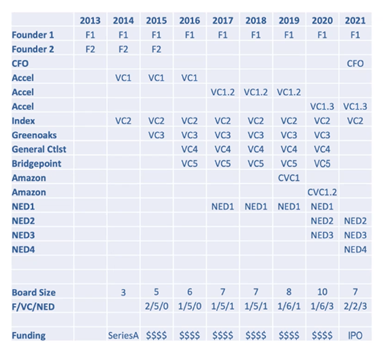
Il m’a semblé intéressant de regarder l’évolution de ce cas d’école en observant son board, et d’illustrer ce qui s’est passé pendant les 8 ans qui ont précédé l’IPO de demain.
Historiquement:
2 fondateurs en 2013 (un quitte en 2016)
Arrivée de 2 VC dès 2014
Evolution du Board de 3 à 10 entre 2015 et 2020
Arrivée d’un CVC massif au bout de 6 ans (Amazon)
Arrivée du premier NED 4 ans après la Serie A
Arrivée massive de plusieurs Non Executive Director à l’approche de l’IPO
Gouvernance peu indépendante surtout au début
2 levées de fonds majeures chaque année.
Un Super CFO qui arrive pour l’IPO.
Nous verrons bien ce que l’IPO donnera demain. 390 cents par action. Objectif, le milliard de livres sterling.
Et vous,
pensez-vous que le modèle est réplicable ?
d’ailleurs est-ce plutôt un modèle ou un contre-modèle ?
selon vous, qui sera le prochain Deliveroo ?
Pour en savoir plus sur ce sujet, je vous recommende:









 Shaping tomorrow
Vous devez être connecté pour poster un commentaire.